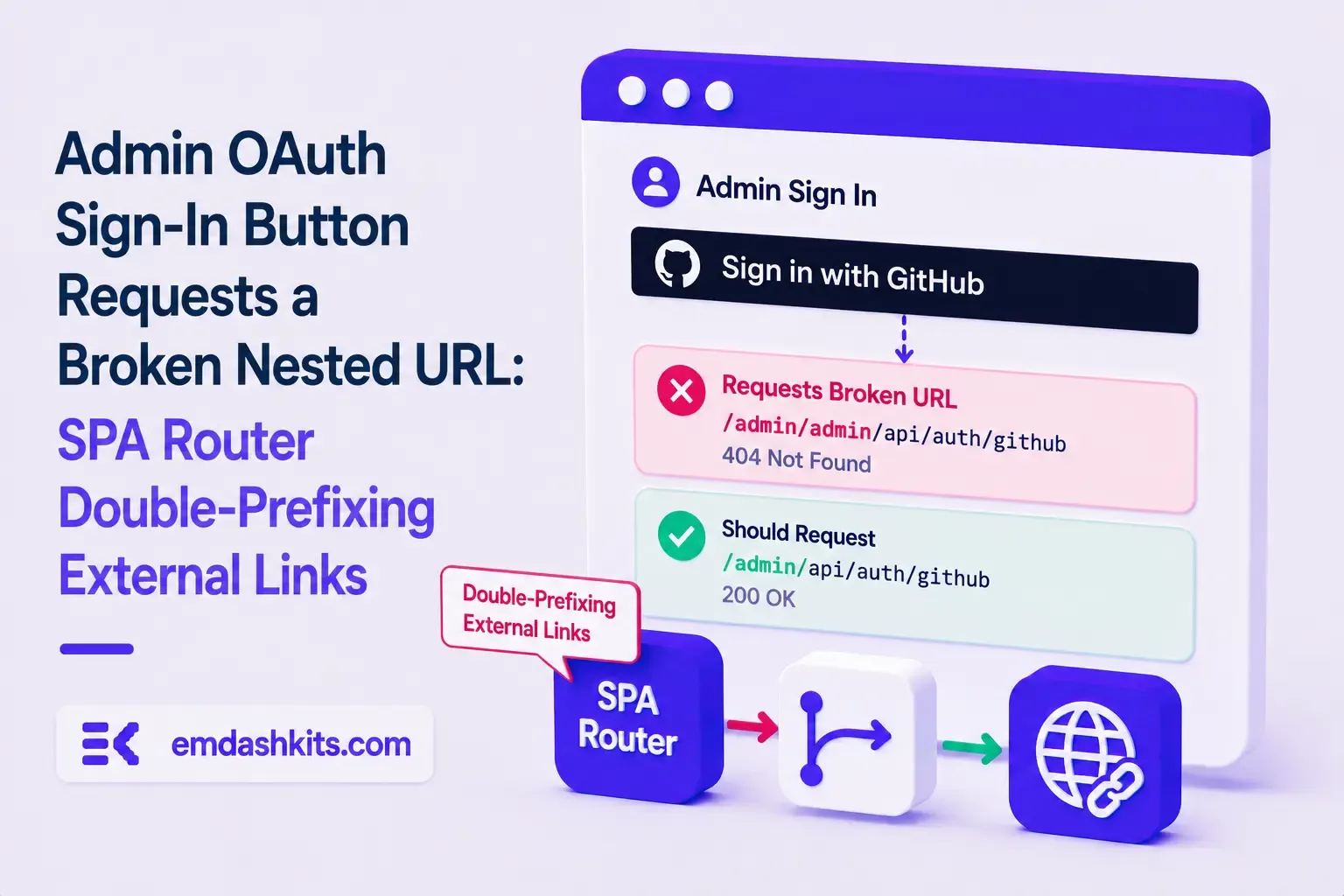
TL;DR — The admin panel's GitHub/Google sign-in buttons requested a nonexistent nested path instead of the real OAuth endpoint. The admin SPA's own router-link component treats any href starting with "/" as an internal route and prepends the admin's basepath — even when the href intentionally points outside the SPA to a real server endpoint like /_emdash/api/auth/oauth/github.
Clicking a social sign-in button sends a request to something like the admin basepath prepended twice onto the real API path — a route that was never meant to exist and 404s.
Root cause
The router-link component has no exception for hrefs that intentionally point outside the SPA to a real server route; it decorates every /-prefixed href identically, whether it's a client-side route or not.
Apply the patch through the build script (patch-package && astro build) rather than a postinstall hook, if the project's .npmrc already sets ignore-scripts=true for an unrelated native-module fix — a postinstall hook would silently never run.
Lessons learned
Any client-side router component that auto-decorates href="/..." links needs an explicit escape hatch for hrefs that are correct exactly as written and point outside the SPA.
This is a different bug from a public-facing post-link double-prefix issue — same symptom shape (a duplicated path segment), completely different mechanism (client router basepath injection vs. a locale-aware entry id).
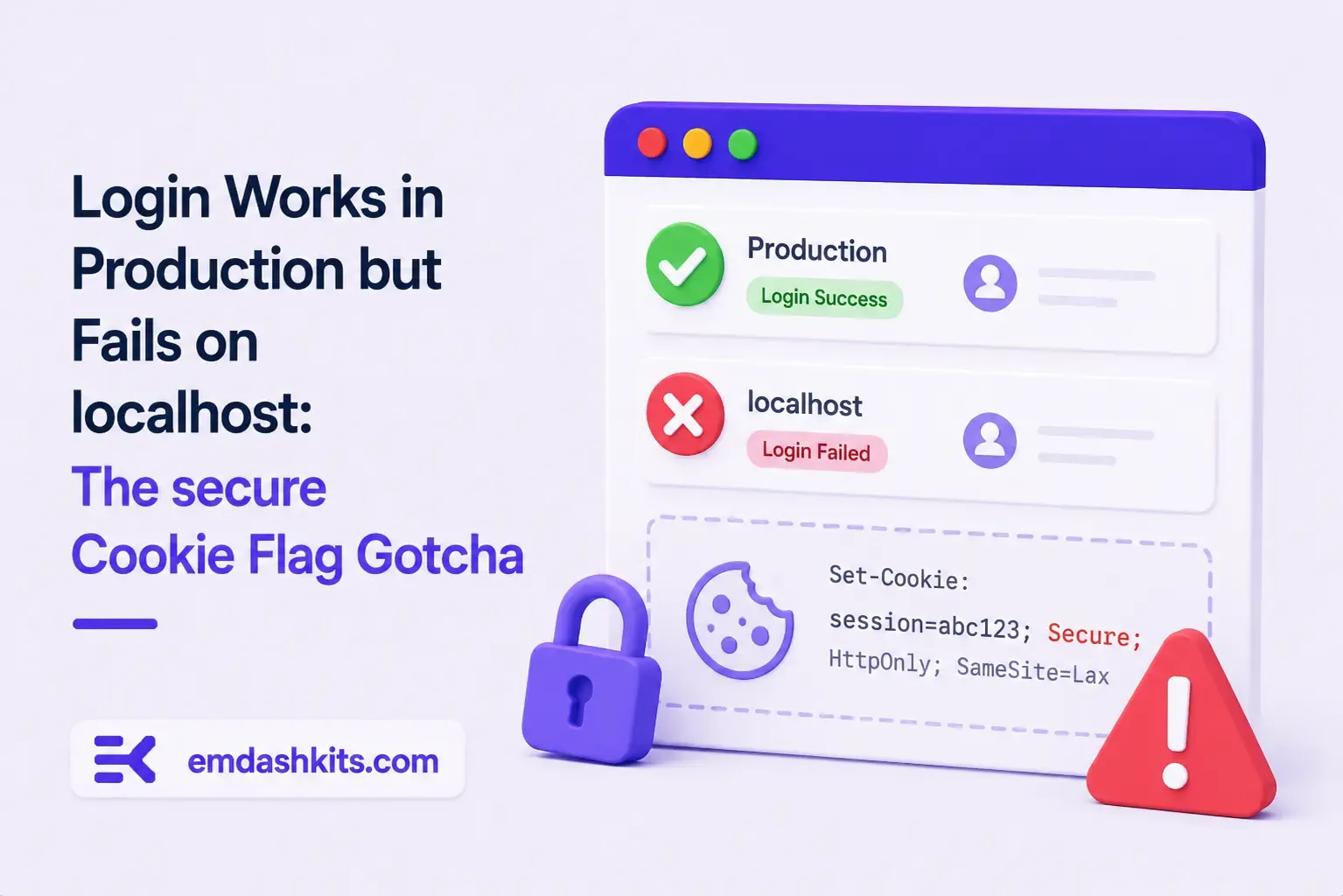
TL;DR — A custom session-cookie login flow appeared to succeed on localhost (the OTP verified, the response looked fine) but every subsequent request to a login-gated page treated the visitor as logged out. Identical code worked fine on the live HTTPS site. The cookie's Secure attribute was hardcoded to true — and per the cookie spec, browsers never store or send a Secure cookie over a plain, non-HTTPS connection.
Check the actual Set-Cookie response header and the browser's own cookie storage panel — on localhost over http://, the cookie is sent by the server but never actually stored by the browser.
Root cause
// before -- assumes the app is always served over HTTPS
setCookie("session", token, { secure: true, httpOnly: true });
emdashkits.com
A cookie config that quietly assumes "we're always on HTTPS" breaks the instant you test over plain HTTP, which local dev servers commonly are.
// after -- derive secure from the actual request protocol
const isHttps = request.url.startsWith("https://");
setCookie("session", token, { secure: isHttps, httpOnly: true });
emdashkits.com
Lessons learned
Any Secure-flagged cookie needs to key off the real request scheme, not an assumption baked in once at cookie-creation time.
"Works in production, silently fails in local dev" is a strong signal to check cookie flags before anything else in an auth flow.
Check other cookies in the same codebase for the same hardcoded assumption — if one cookie has this bug, sibling cookies set the same way are worth auditing too.
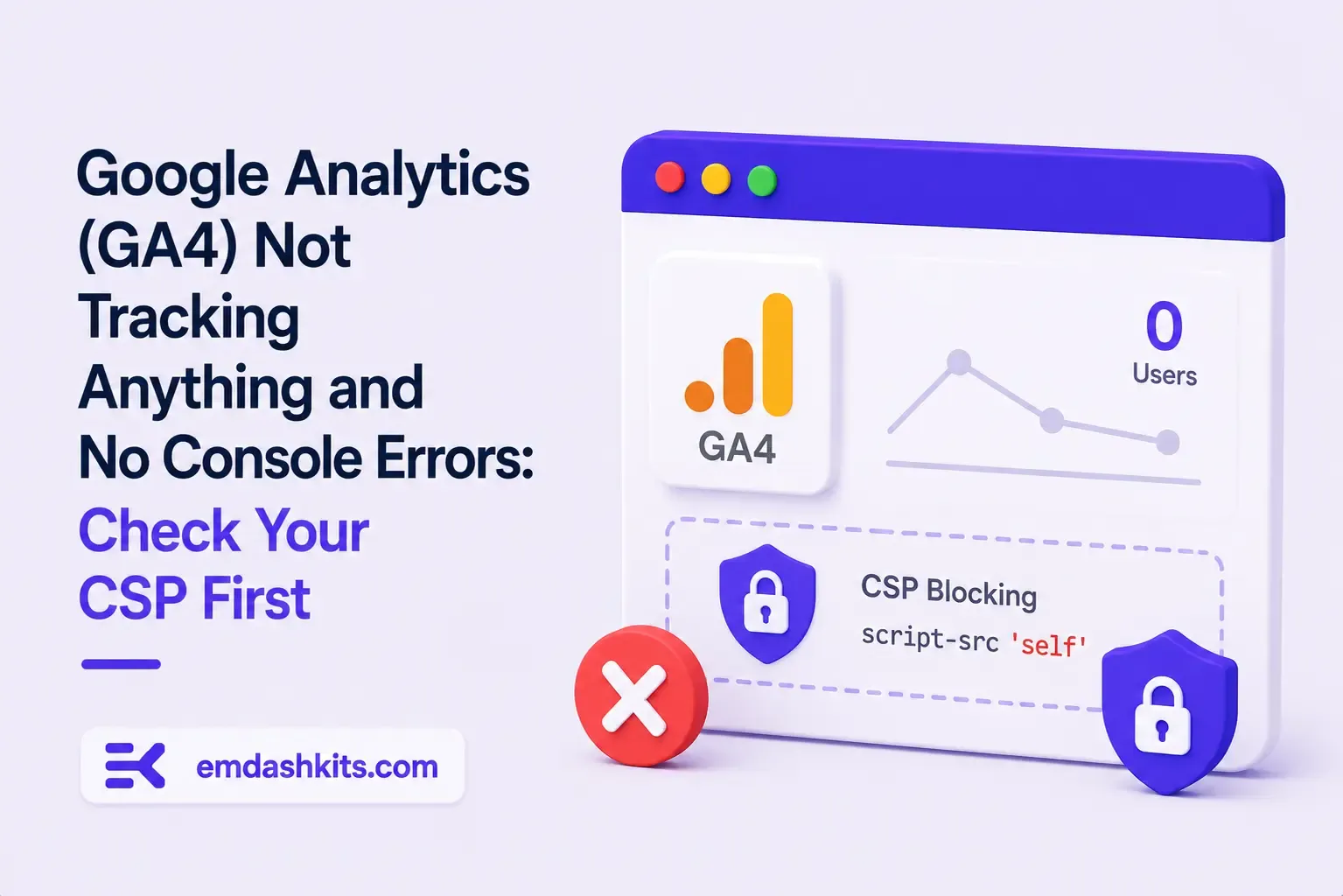
TL;DR — GA4's gtag.js snippet was installed correctly, the page loaded with no visible JavaScript error, and GA4's real-time report still showed zero activity. The CMS's default Content-Security-Policy had no allowance for analytics domains and no config option to add one — so every request to Google's tracking endpoints was blocked at the browser level before it could fail loudly.
Check the browser's dedicated CSP violation reporting, not the regular console error list — CSP blocks are reported through their own channel, not thrown as normal script errors, so "no console errors" doesn't mean nothing was blocked.
Root cause
The CSP's script-src and connect-src directives had no entry for googletagmanager.com or google-analytics.com, and the CMS exposed no configuration surface to add one — the only way in was patching the CSP directives directly.
// patch-package: add analytics domains to the existing CSP directives
scriptSrc.push("https://www.googletagmanager.com");
connectSrc.push("https://www.google-analytics.com", "https://www.googletagmanager.com");
"No console errors" is not proof nothing was blocked — CSP violations live in their own reporting surface and are easy to miss if you're only scanning for red error text.
Before adding any third-party script tag to a site with a CSP already in place, check the CSP's directives first rather than assuming a silently-empty analytics dashboard means a snippet-installation mistake.



Comments