Best Fast-Loading CMS for Core Web Vitals

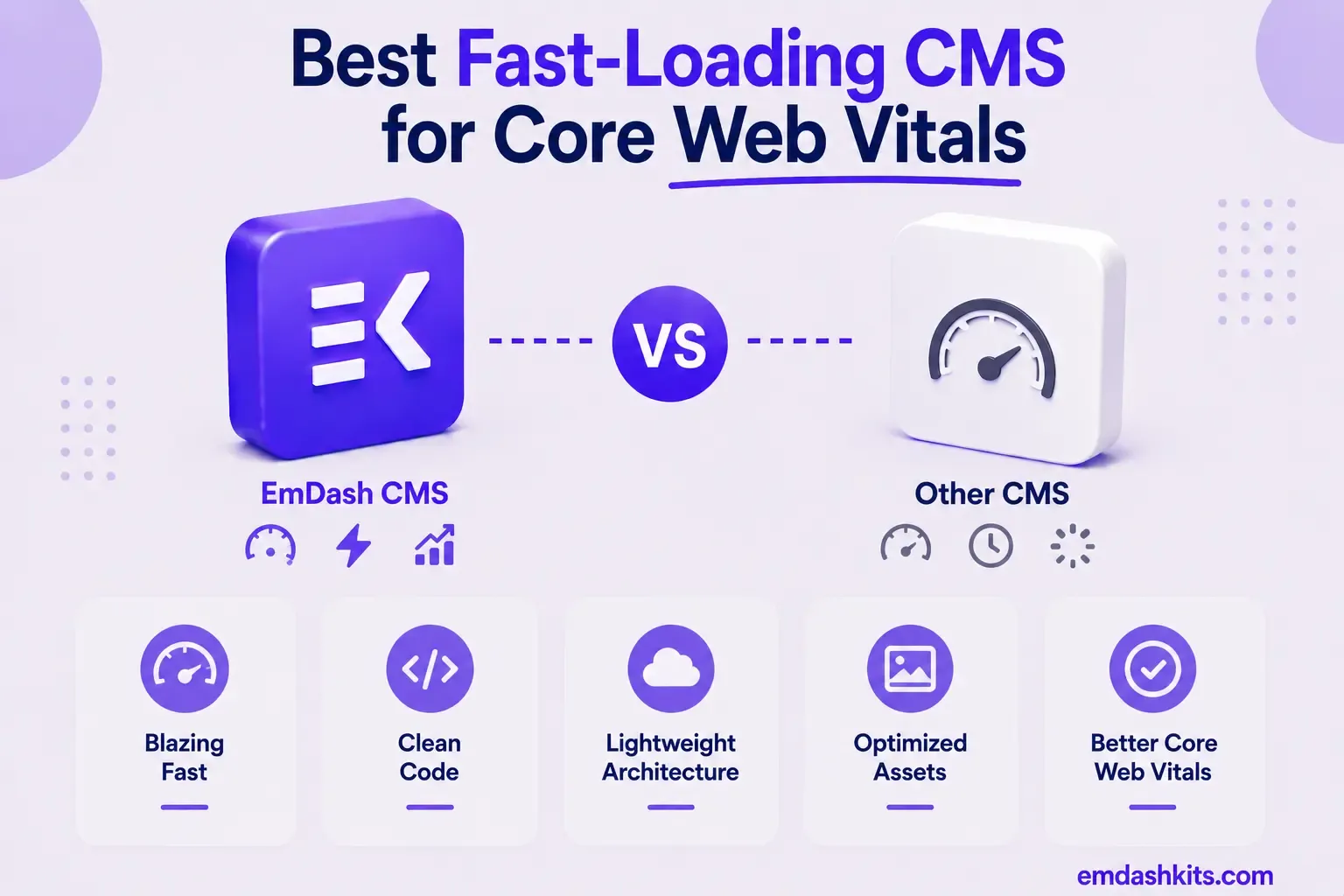
Core Web Vitals performance isn't primarily a settings problem — it's an architecture problem. A CMS that renders every page on-demand from a database, on shared hosting, starts from a fundamentally different performance ceiling than one that ships static or edge-rendered HTML. This guide compares platforms by that architectural reality, not by how much optimization effort you're willing to put in afterward.
Table of Contents
- Why the Gap Is Architectural, Not Just Configuration
- The Platforms, by Rendering Architecture
- EmDash CMS — Best for a Near-Zero-JS Performance Ceiling by Default
- Webflow — Best Out-of-the-Box Performance Without Any Optimization Work
- WordPress — Best Optimization Ceiling for Teams Willing to Invest
- Wix and Squarespace — Fast Mobile Pass Rates, With a Real Caveat
- How to Actually Choose
- Frequently Asked Questions
- Does CMS choice matter more than hosting for Core Web Vitals?
- Is INP as important as LCP for CMS performance in 2026?
- Can a slow CMS be fixed with optimization alone?
- Is Core Web Vitals actually a ranking factor worth prioritizing?
- The Bottom Line
- Sources
Why the Gap Is Architectural, Not Just Configuration
Webflow sites average 2.3 times faster LCP scores than WordPress, due to not having a server-side rendering step for each request — Webflow sites are essentially static HTML served from CDN. Without a CDN, a standard WordPress site on shared hosting will have TTFB of 500ms-2000ms, while Webflow consistently achieves 250-400ms. WordPress runs on every tier of hosting from $3 shared plans to enterprise managed clusters — its optimization ceiling is the highest, but its floor is the lowest.
That last point matters more than it sounds: WordPress's performance variance is enormous specifically because it runs on wildly inconsistent hosting, from cheap shared plans to serious managed infrastructure. A well-optimized WordPress stack can be genuinely fast — but getting there takes real, ongoing effort most site owners never invest. Platforms that ship a narrower, more controlled hosting and rendering path (Webflow, Wix, Squarespace, or a modern static/edge-rendered headless CMS) have a much higher performance floor by default, simply because there's less room for a bad configuration to tank it.
The Platforms, by Rendering Architecture
EmDash CMS — Best for a Near-Zero-JS Performance Ceiling by Default
EmDash's Astro-based front end ships minimal JavaScript by default — Astro's "islands" architecture only hydrates the specific interactive components a page actually needs, rather than shipping a full framework bundle for a mostly-static page. Combined with self-hosted infrastructure you control (rather than shared hosting tiers), this gives EmDash sites a genuinely high performance ceiling without Webflow's or Squarespace's rendering constraints. Full comparison: EmDash CMS vs WordPress.
Webflow — Best Out-of-the-Box Performance Without Any Optimization Work
Webflow's essentially-static-HTML-from-CDN model delivers strong LCP and TTFB by default, with no developer optimization work required — a real advantage for teams without dedicated performance engineering. Its 2026 pricing changes (reduced default bandwidth) are worth checking against a high-traffic site's actual usage. Full comparison: EmDash CMS vs Webflow.
WordPress — Best Optimization Ceiling for Teams Willing to Invest
WordPress's floor is the lowest of any major platform on cheap shared hosting, but its ceiling — with a CDN, a lightweight theme, and careful plugin discipline — can genuinely compete with static-first platforms. Switching from a heavy builder like Elementor to the native block editor or a lightweight theme can improve LCP by 1-2 seconds on its own. Full comparison: EmDash CMS vs WordPress.
Wix and Squarespace — Fast Mobile Pass Rates, With a Real Caveat
Wix and Squarespace post some of the highest Core Web Vitals pass rates on mobile, largely because they tightly control theme, image delivery, and hosting end to end. That's a genuinely strong default for a typical small site. The caveat, worth weighing specifically if you're in a competitive niche: our deeper research into Squarespace found real LCP concerns (3-5 seconds on mobile in audited sites) tied to large JavaScript bundles loaded on every page regardless of whether a page uses those features — see our full breakdown in our Squarespace alternatives guide for the nuance behind that specific finding.
How to Actually Choose
- If you want a high performance ceiling with full infrastructure control: EmDash.
- If you want strong performance with zero optimization effort: Webflow.
- If you're willing to invest in ongoing optimization for maximum flexibility: WordPress (with a CDN and lightweight theme).
- If you're a small site prioritizing simplicity over competitive-niche SEO: Wix or Squarespace.
Frequently Asked Questions
Does CMS choice matter more than hosting for Core Web Vitals?
They're linked — a CMS's architecture determines its hosting flexibility and rendering model, which together set the real performance ceiling. WordPress on excellent managed hosting can outperform a poorly-configured static site, but the platforms with the most consistent defaults (Webflow, Astro-based headless CMS platforms) require the least effort to get there.
Is INP as important as LCP for CMS performance in 2026?
Increasingly, yes — Interactive to Next Paint has become a significant Core Web Vitals concern, particularly for JavaScript-heavy platforms. This is another area where minimal-JS architectures (like Astro's islands model) have a structural advantage over platforms shipping large client-side bundles by default.
Can a slow CMS be fixed with optimization alone?
Often significantly improved, rarely fully solved — a CMS built around heavy server-side rendering or large default JavaScript bundles has a lower performance ceiling than one architected for minimal rendering overhead, no matter how much optimization effort you apply on top.
Is Core Web Vitals actually a ranking factor worth prioritizing?
It's one of many Google ranking signals, most impactful in competitive search niches where content quality is otherwise similar across competitors — in that specific scenario, a meaningful Core Web Vitals gap can be a real differentiator, which is exactly the situation our Squarespace research flagged.
The Bottom Line
CMS performance in 2026 comes down to rendering architecture more than any single optimization trick — platforms that ship minimal JavaScript by default (EmDash's Astro foundation, Webflow's static output) have the highest performance floor, while WordPress offers the highest ceiling for teams willing to invest in getting there. Choose based on how much ongoing optimization effort your team realistically has, not just a platform's marketing claims.


Comments