Best CMS for Real Estate Websites

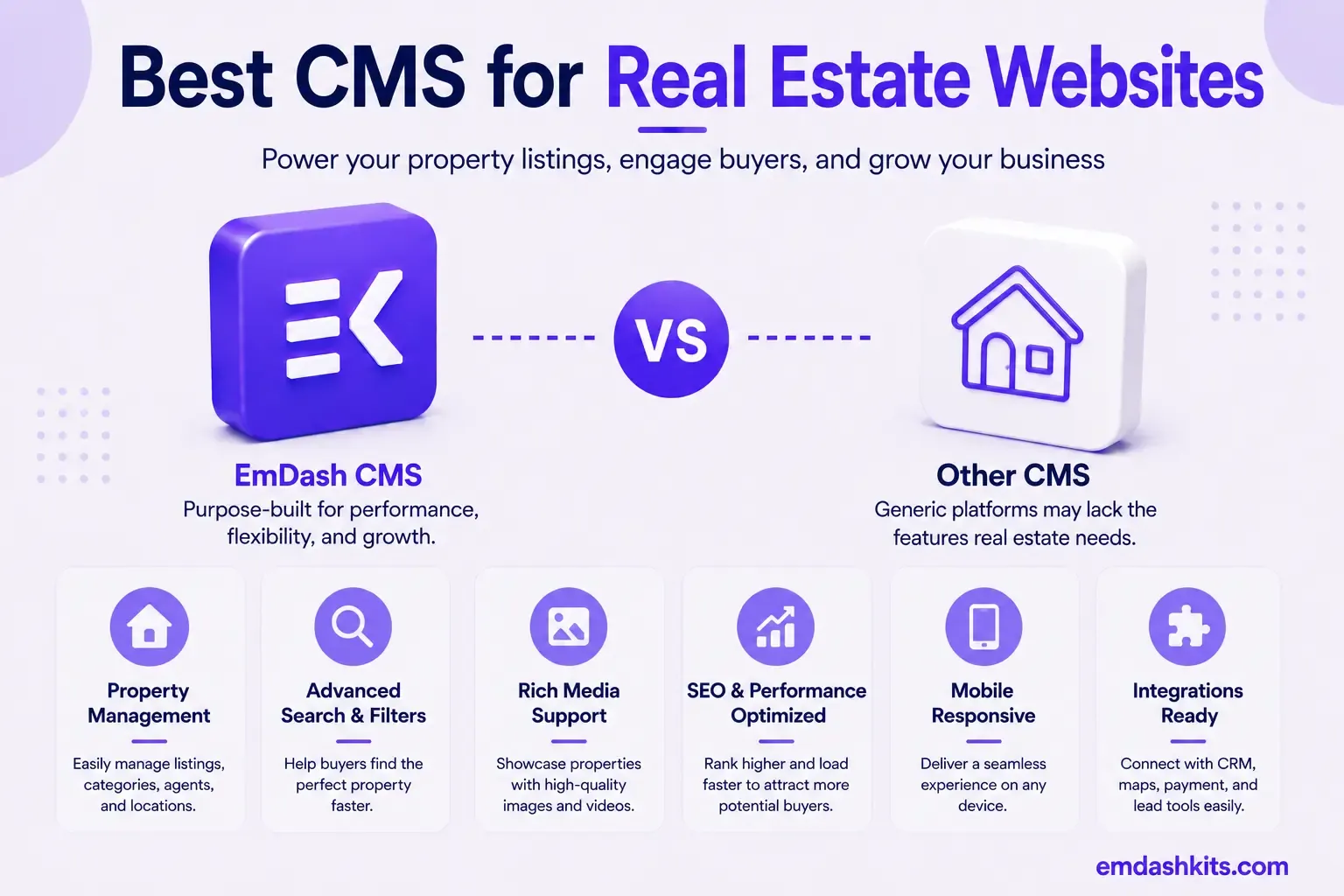
A real estate website lives or dies on one specific capability most other business websites never need: IDX/MLS integration, pulling live property listings from your local Multiple Listing Service into your own site. This guide compares the platforms built specifically for that, and where a general-purpose CMS fits into the picture.
Table of Contents
- Why This Category Is Different
- The Platforms, by Agent or Brokerage Need
- Purpose-Built Real Estate Platforms — Best for Native IDX, CRM, and Lead Capture in One System
- WordPress with a Dedicated IDX Plugin — Best for Flexibility and Content Marketing
- IDX Broker — Best for a Turnkey, Professionally Designed Site with Predictable Pricing
- Squarespace or Wix — Best for a Simple Agent Site Without Deep IDX Needs
- Where EmDash Fits — And Doesn't
- How to Actually Choose
- Frequently Asked Questions
- What is the RESO Web API, and why does it matter?
- Is WordPress with an IDX plugin as good as a purpose-built real estate platform?
- How much should I expect to pay for real estate website software?
- Can I use a general-purpose CMS like EmDash for a real estate site?
- The Bottom Line
- Sources
Why This Category Is Different
In real estate, the best CMS for your website is one that also handles IDX/MLS integration, lead capture, and analytics natively, rather than requiring you to add those features through third-party plugins. Platforms like BoldTrail outperform standalone IDX tools that require manual CRM entry or third-party integration by combining strong MLS coverage, native CRM integration, and behavioral lead capture. In 2026, most MLS organizations deliver data through the RESO Web API, which has largely replaced the older RETS feed.
That's the real fork in this category: a purpose-built real estate platform with IDX and CRM natively integrated, versus a general-purpose CMS (usually WordPress) with a dedicated IDX plugin layered on top. Both are legitimate paths — the purpose-built platforms reduce integration friction at a real cost premium, while a general CMS plus a strong IDX plugin gives more flexibility and often lower total cost, at the price of more moving parts to maintain.
The Platforms, by Agent or Brokerage Need
Purpose-Built Real Estate Platforms — Best for Native IDX, CRM, and Lead Capture in One System
Platforms like BoldTrail, Luxury Presence, and iHomefinder are purpose-built specifically for real estate, integrating MLS data, CRM, and behavioral lead capture natively — iHomefinder in particular is noted for automating engagement and sending clean data into your CRM rather than forcing agents to stitch together multiple tools. Best for agents or brokerages who want the least integration friction and are willing to pay a premium for it.
WordPress with a Dedicated IDX Plugin — Best for Flexibility and Content Marketing
WordPress paired with a dedicated IDX plugin like Showcase IDX — noted for search experience and UX design considered head and shoulders above competitors — gives you real estate functionality on top of WordPress's much stronger content marketing and SEO capabilities than most purpose-built real estate platforms offer natively. Best for agents who want serious blog/content-driven lead generation alongside listings. Full comparison: EmDash CMS vs WordPress.
IDX Broker — Best for a Turnkey, Professionally Designed Site with Predictable Pricing
IDX Broker's tiered plans — Core at $60/month, Engage at $99/month, Elite at $149/month — include a full professionally designed website alongside IDX search, a clear, predictable cost structure for an agent who wants a complete package without assembling separate CMS and IDX tools.
Squarespace or Wix — Best for a Simple Agent Site Without Deep IDX Needs
For a solo agent whose primary need is a professional presence and basic contact/lead capture — not deep MLS search functionality — a general no-code builder like Squarespace or Wix, potentially paired with a lighter third-party IDX widget, can be a reasonable, lower-cost starting point. Full comparisons: EmDash CMS vs Squarespace and EmDash CMS vs Wix.
Where EmDash Fits — And Doesn't
EmDash has no native IDX/MLS integration or real estate-specific tooling — building that would mean custom development against the RESO Web API, a real engineering project most agents and even most brokerages shouldn't take on themselves. It's not a realistic choice for a typical real estate website. Full comparison: EmDash CMS vs WordPress.
How to Actually Choose
- If you want native IDX, CRM, and lead capture with the least integration friction: a purpose-built platform like BoldTrail or Luxury Presence.
- If content marketing and SEO matter as much as listings: WordPress with a strong IDX plugin like Showcase IDX.
- If you want a complete, predictably priced turnkey package: IDX Broker.
- If your needs are simple and IDX depth isn't critical: Squarespace or Wix.
Frequently Asked Questions
What is the RESO Web API, and why does it matter?
It's the modern standard most MLS organizations now use to deliver listing data, replacing the older RETS feed. A platform or plugin built against the current RESO Web API standard will integrate more reliably and get feature updates faster than one still relying on legacy data delivery methods.
Is WordPress with an IDX plugin as good as a purpose-built real estate platform?
It can be, and it offers meaningfully better content marketing capability — the trade-off is more setup and maintenance responsibility, since you're combining a general CMS with a third-party plugin rather than getting native integration out of the box.
How much should I expect to pay for real estate website software?
It varies widely — turnkey platforms like IDX Broker start around $60/month for a complete package, while purpose-built platforms with deeper CRM and lead-capture tooling (BoldTrail, Luxury Presence) typically cost more. A WordPress-plus-plugin approach can be cheaper in direct software cost but requires more setup time.
Can I use a general-purpose CMS like EmDash for a real estate site?
Not practically — you'd need custom development against the RESO Web API and no existing real estate ecosystem to draw on, which is a significant, unnecessary engineering investment when purpose-built tools already solve this well.
The Bottom Line
Real estate is one of the clearest cases in this series where a general-purpose CMS isn't the right call — the IDX/MLS integration requirement is specific enough that purpose-built real estate platforms, or WordPress with a dedicated IDX plugin, are the honest starting points. See our broader guide to the best CMS for small business websites if your real estate business also needs a broader marketing site beyond listings.

Comments