Best CMS for Small Business Websites

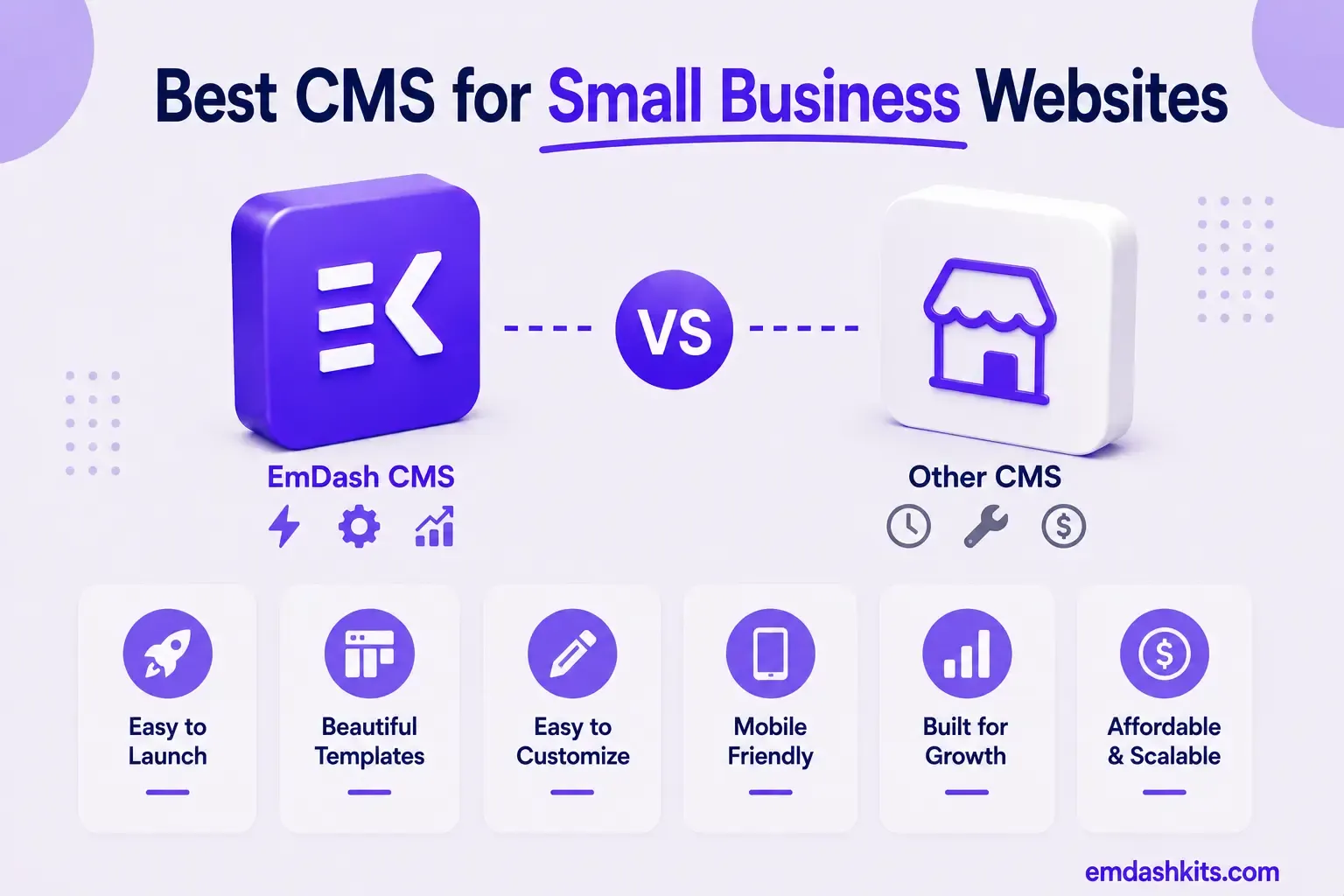
Most "best CMS for small business" lists quietly assume you have a developer on staff, which most small businesses don't. This guide starts from the honest version of that question: what should a small business owner without a technical team actually use, and where does a more powerful, developer-oriented platform like EmDash genuinely fit — and where does it clearly not.
Table of Contents
- There's No Universal Answer — Only the Right Fit
- The Platforms, by Small Business Type
- Wix — Best for the Fastest Possible Launch, No Developer Needed
- Squarespace — Best for Professional Design Without Ongoing Maintenance
- WordPress — Best for Content-Driven Growth and SEO
- Webflow — Best for a Design-Led Small Business That Wants a Custom Look
- EmDash CMS — Best Only If You Have (or Are Hiring) a Developer
- How to Actually Choose
- Frequently Asked Questions
- Do I need a developer to build a small business website in 2026?
- Should a small business ever choose a headless CMS like EmDash?
- What's the biggest mistake small businesses make choosing a CMS?
- Is it expensive to switch platforms later if I outgrow my first choice?
- The Bottom Line
- Sources
There's No Universal Answer — Only the Right Fit
There's no one-size-fits-all CMS. The best pick really depends on what you need, not just which platform boasts the most features. Wix and Squarespace are the easiest CMS platforms for beginners, offering drag-and-drop tools with no technical skills required. Squarespace excels at building easily maintainable websites for service-based businesses, solopreneurs, and creative industries. Webflow is ideal for designers wanting pixel-perfect custom layouts without code. WordPress.com is unmatched for blogs, SEO, and content-driven growth.
That's a genuinely useful framing — the "best" platform splits by what kind of small business you are, not by a single feature checklist. A solo consultant, a local service business, a growing ecommerce brand, and a content-driven publisher all have different real requirements, even though they'd all technically be described as "small business."
The Platforms, by Small Business Type
Wix — Best for the Fastest Possible Launch, No Developer Needed
Wix's AI-assisted builder (Wix ADI) can put together a basic, professional-looking site from a few inputs, with hosting, SEO basics, and business tools bundled in. Genuinely the fastest path to live for a business with zero technical resources. The real trade-off, worth knowing before you invest years of content into it: Wix has no functional data-export feature, so leaving later means manually rebuilding your site elsewhere. Full comparison: EmDash CMS vs Wix.
Squarespace — Best for Professional Design Without Ongoing Maintenance
Squarespace is widely considered the best overall platform for small businesses wanting a modern, professional site that's easy to create and easy to maintain — particularly strong for service businesses, solopreneurs, and creative portfolios. Its real ceiling shows up in competitive-market SEO and large product catalogs, not in day-to-day usability. Full comparison: EmDash CMS vs Squarespace.
WordPress — Best for Content-Driven Growth and SEO
WordPress remains unmatched for blogs, SEO, and content-driven marketing, backed by the largest plugin ecosystem and developer talent pool of any CMS. It requires more hands-on management than Wix or Squarespace (updates, plugin choices, basic security hygiene), which is a real time cost for a small business owner managing it solo. Full comparison: EmDash CMS vs WordPress.
Webflow — Best for a Design-Led Small Business That Wants a Custom Look
Webflow gives a design-conscious small business (an agency, a studio, a boutique brand) pixel-perfect custom layouts without writing code — a real step up in design control from Wix or Squarespace's template-based approach, with a genuinely steeper learning curve to match. Its own 2026 pricing restructuring is worth checking against your expected traffic. Full comparison: EmDash CMS vs Webflow.
EmDash CMS — Best Only If You Have (or Are Hiring) a Developer
Being honest here: EmDash is not the right starting point for a small business without technical resources. It has no visual, drag-and-drop builder — building a site means writing an Astro front end against structured content. Where it genuinely fits is a small business that has outgrown a no-code builder's limits (real SEO control, custom functionality, content structure a template can't express) and either has a developer on staff or is hiring a freelancer/agency to build it. Full comparison: EmDash CMS vs Squarespace.
How to Actually Choose
- If you have zero technical resources and need to launch this week: Wix.
- If you want a professional, low-maintenance site and run a service or creative business: Squarespace.
- If content marketing and SEO are core to your growth strategy: WordPress.
- If design quality and custom layout matter more than launch speed: Webflow.
- If you've outgrown all of the above and have (or are hiring) a developer: EmDash.
Frequently Asked Questions
Do I need a developer to build a small business website in 2026?
No — Wix, Squarespace, and WordPress (with themes) are all genuinely usable by a non-technical business owner. A developer becomes necessary once you need custom functionality, deep SEO control, or a content structure a template-based builder can't express.
Should a small business ever choose a headless CMS like EmDash?
Only once it's outgrown a no-code builder's real limits and has development resources — either an in-house hire or an agency. Choosing a headless CMS before that point usually means paying more (in development time) for capability the business doesn't yet need.
What's the biggest mistake small businesses make choosing a CMS?
Picking based on a generic "best CMS" ranking rather than their actual constraint — technical skill, budget, content type, or growth stage. A ranking optimized for developers isn't useful to a solo business owner, and vice versa.
Is it expensive to switch platforms later if I outgrow my first choice?
It depends on the platform. Migrating off WordPress or Squarespace is generally straightforward since content is portably structured. Migrating off Wix specifically is well-documented as harder, since it has no functional data-export feature — worth weighing before you commit years of content to it.
The Bottom Line
The best CMS for a small business isn't a single platform — it's whichever one matches your actual technical resources, business type, and growth stage today. Start with a no-code builder if you don't have development resources, and only consider a structured, developer-oriented platform like EmDash once you've genuinely outgrown what a builder can do. See our broader roundup of the strongest WordPress alternatives across every use case if content-driven growth is your priority.
Comments