Best Drupal Alternatives in 2026 (Including EmDash CMS)

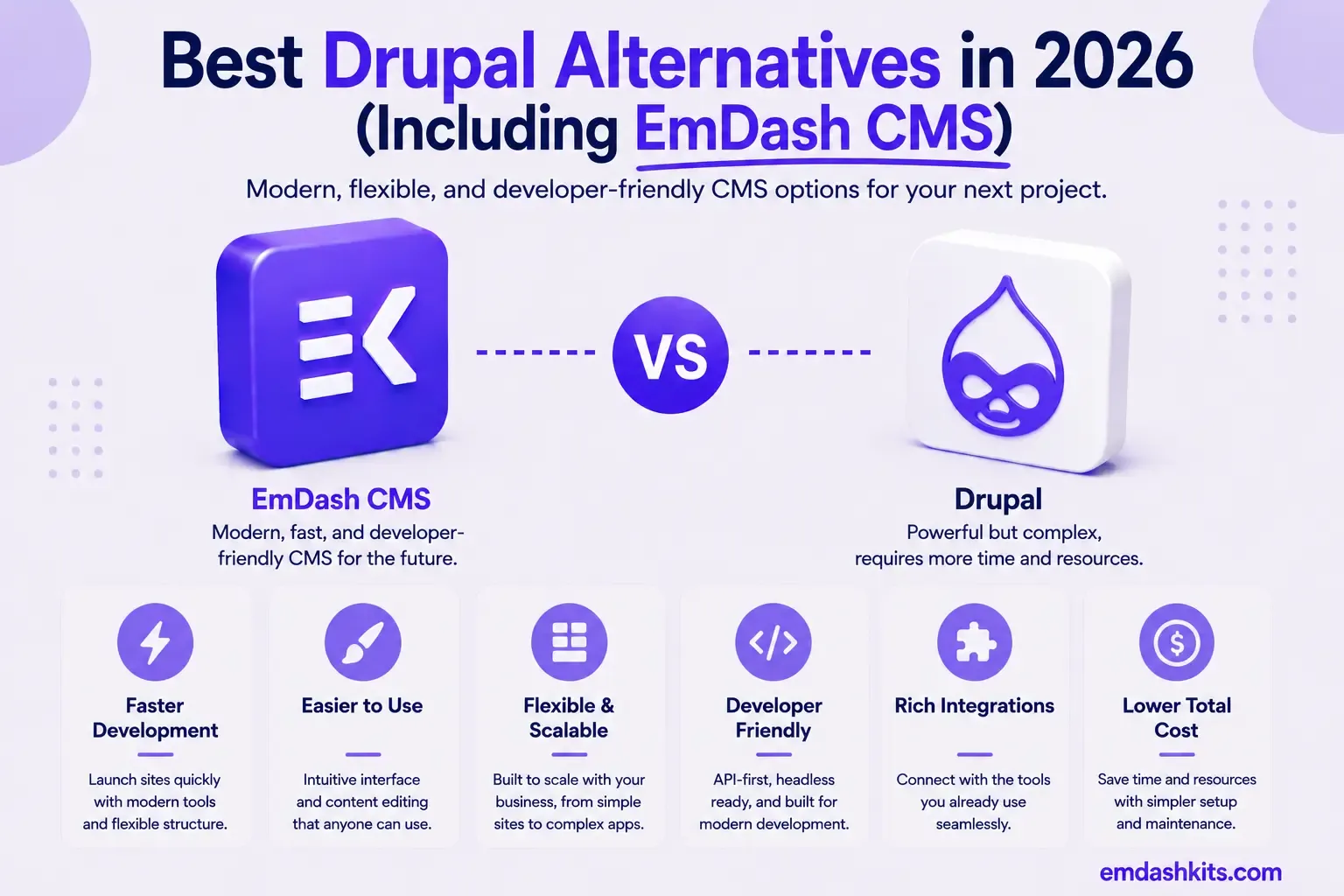
Drupal remains the standard choice for organizations with genuine, complex security and governance requirements — but the platform's own numbers tell a concerning story for anyone planning a long-term investment in it. This guide rounds up the strongest alternatives for teams weighing Drupal's real strengths against its shrinking talent pool and rising maintenance cost.
Table of Contents
- The Talent Pipeline Has Nearly Stopped
- The Alternatives, Organized by What You Need
- EmDash CMS — Best for Structured Content with a Growing, Not Shrinking, Talent Pool
- WordPress — Best for the Largest Available Developer Pool
- Umbraco — Best for Teams Already Invested in .NET
- Craft CMS — Best for Agencies Wanting Predictable, Lower-Maintenance PHP
- Contentful — Best for Enterprise Governance Without Self-Hosted Maintenance
- How to Actually Choose
- Frequently Asked Questions
- Is Drupal actually dying, or is this overstated?
- Do I need to migrate off Drupal immediately?
- What's driving Drupal's maintenance burden specifically?
- Is EmDash a realistic replacement for Drupal's enterprise governance features?
- The Bottom Line
- Sources
The Talent Pipeline Has Nearly Stopped
Drupal's market share has slipped to 0.7% of all websites, causing the developer pool to shrink accordingly. Developer optimism dropped from 80% in 2024 to 64% in 2025, and when researchers looked at developers with less than one year of experience, they found just 11 globally. The talent pipeline has nearly stopped. Comprehensive Drupal maintenance typically requires 25 to 35 developer hours per month just to keep a site running securely.
That's not a minor hiring inconvenience — it's a structural risk for any organization planning to run Drupal for the next five or ten years. Fewer new developers entering the ecosystem means rising rates for the specialists who remain, longer timelines for hiring, and more institutional risk if a key Drupal developer leaves. Combined with 25-35 monthly maintenance hours just to stay secure, and major version upgrades that require substantial rebuilding, the total cost of ownership is real and climbing, independent of Drupal's actual feature set.
The Alternatives, Organized by What You Need
EmDash CMS — Best for Structured Content with a Growing, Not Shrinking, Talent Pool
EmDash's TypeScript/Astro stack draws from one of the largest and fastest-growing developer pools in the industry — the opposite of Drupal's talent trajectory. Its sandboxed plugin security addresses the same governance instincts that draw organizations to Drupal, without Drupal's module-upgrade fragility. Full comparison: EmDash CMS vs Drupal.
WordPress — Best for the Largest Available Developer Pool
WordPress remains the single largest CMS talent pool in the world by a wide margin — the practical opposite of Drupal's scarcity problem. The trade-off is WordPress's own well-documented plugin-security exposure, a different risk than Drupal's maintenance burden but a real one to weigh. Full comparison: EmDash CMS vs WordPress.
Umbraco — Best for Teams Already Invested in .NET
Umbraco is open-source with over 500,000 active installs and a stable, if smaller than WordPress's, developer community — a reasonable landing spot for organizations (especially government and enterprise .NET shops, Drupal's traditional strongholds) that want an open-source CMS without Drupal's specific talent-scarcity trend. Full comparison: EmDash CMS vs Umbraco.
Craft CMS — Best for Agencies Wanting Predictable, Lower-Maintenance PHP
Craft's single-language PHP/Twig stack and lower plugin dependency are specifically positioned as lower long-term maintenance overhead than more fragmented systems — a real answer to Drupal's module-upgrade fragility, with a one-time license instead of Drupal's ongoing enterprise support contracts. Full comparison: EmDash CMS vs Craft CMS.
Contentful — Best for Enterprise Governance Without Self-Hosted Maintenance
For organizations whose real reason for choosing Drupal was enterprise governance and multi-site management rather than a specific technical requirement, Contentful's fully managed SaaS model delivers similar governance controls without the self-hosted maintenance burden — worth weighing against Contentful's own 2026 developments (the Salesforce acquisition and steep pricing increases). Full comparison: EmDash CMS vs Contentful.
How to Actually Choose
- If you want a modern stack with a growing developer pool and sandboxed plugin security: EmDash.
- If talent availability is your single biggest concern: WordPress.
- If your organization is already standardized on .NET: Umbraco.
- If you're an agency wanting lower long-term maintenance overhead: Craft CMS.
- If your real need is managed governance, not self-hosting specifically: Contentful.
Frequently Asked Questions
Is Drupal actually dying, or is this overstated?
Overall market share has fallen sharply, but Drupal remains disproportionately strong among the highest-traffic, most complex sites — governments, universities, large enterprises — where its security hardening and governance tooling are still genuinely valued. The concern isn't Drupal disappearing; it's the shrinking talent pool making it more expensive and riskier to staff long-term.
Do I need to migrate off Drupal immediately?
Not necessarily — for a stable, well-maintained Drupal site with an existing team, the migration cost and risk may outweigh the benefit. The alternatives matter most for new projects, or for existing sites facing a genuine staffing crisis finding qualified Drupal developers.
What's driving Drupal's maintenance burden specifically?
Its own flexibility — every customization and integration typically requires custom developer work rather than configuration, and accumulated years of modules and customizations make upgrades unpredictable, since one change can break something in an unrelated part of the site.
Is EmDash a realistic replacement for Drupal's enterprise governance features?
For structured content and plugin-security governance, yes, conceptually — EmDash's sandboxed permission model addresses similar instincts. For Drupal's most complex enterprise-specific features (deep multi-site management, decades of accumulated compliance tooling), it's a newer platform without that same depth yet.
The Bottom Line
Drupal's core capability is still real for organizations with genuine complexity and governance needs — the risk is specifically the shrinking talent pool and rising maintenance cost that come with staying on it long-term. If you need Drupal's governance instincts on a more sustainable talent pool, EmDash or Craft CMS are the strongest modern alternatives; if talent availability alone is the deciding factor, WordPress remains unmatched in raw pool size. See our broader guide to what enterprise CMS buyers actually prioritize for more on this evaluation.
Comments