Enterprise CMS Explained: What to Look For

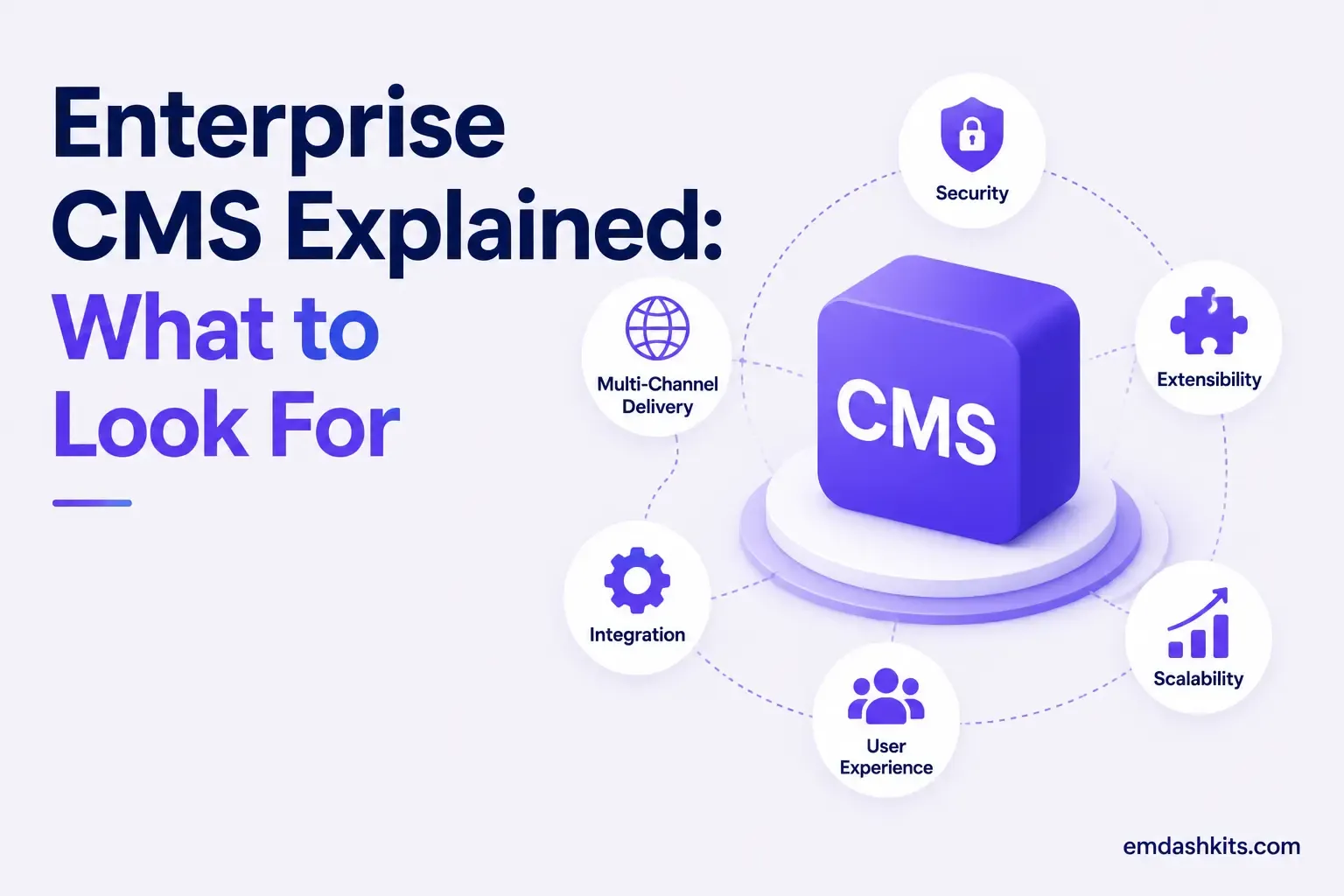
"Enterprise CMS" gets used loosely enough that it's worth being precise about what actually changes once an organization crosses into enterprise scale. It's not just a bigger version of the same checklist a small team uses — security posture, governance, and integration depth all become first-order requirements instead of nice-to-haves.
Table of Contents
Security and Compliance Come First
Enterprise buyers expect role-based access control, single sign-on, encryption at rest and in transit, and full audit logs as table stakes, not premium add-ons. Depending on the industry, that extends to specific frameworks: SOC 2 Type II, ISO 27001, GDPR, and HIPAA show up constantly in enterprise CMS procurement, and regulated organizations — government, finance, healthcare — often specifically require NIST SP 800-53 alignment covering content integrity, access control, audit logging, and configuration management.
This is also where the security case for headless and MACH-aligned architecture becomes concrete rather than theoretical: a smaller attack surface and API-scoped, read-only access keys are easier to defend in an audit than a monolithic admin panel with broad plugin permissions.
Scale Means More Than Traffic
Multi-Site and Multi-Brand Support
A single enterprise CMS instance often needs to serve multiple brands, regions, or business units — each with its own content, design system, and publishing workflow, but shared infrastructure and governance underneath. Bolting this onto a platform that assumes "one site, one install" gets expensive and fragile fast.
Global Content Delivery
Scale in an enterprise context means staying responsive during a product launch, serving content with acceptable latency across regions, and keeping performance stable as content volume grows year over year — which in practice means cloud-native hosting, CDN support, and performance monitoring the team can actually act on, not just a dashboard.
Localization at Volume
Multi-language support isn't a checkbox for global organizations — it's an entire workflow: translation pipelines, locale-specific publishing schedules, and fallback logic when a translation isn't ready yet. This is one of the areas where a platform's underlying content model matters more than its editor UI.
Integration Depth
Enterprise content rarely lives in isolation. It needs to connect to CRM, ERP, analytics, marketing automation, and increasingly AI tooling, for a genuinely unified operation rather than content management as an island. An API-first architecture is what makes this integration depth realistic instead of a series of brittle one-off exports.
MACH and Composable Architecture at Enterprise Scale
Enterprise buyers increasingly evaluate platforms against MACH principles specifically because the alternative — a single monolithic suite trying to do content, commerce, personalization, and search all at once — tends to become the bottleneck exactly when an enterprise needs to move fastest. A composable approach lets different business units adopt best-of-breed tools for their specific needs while sharing a common content layer, rather than every team being blocked on the same vendor's roadmap.
That said, not every enterprise workload needs a fully composable rebuild on day one. Many organizations land on a hybrid CMS as the practical middle ground — headless flexibility for the properties that need it, with a built-in front end still available for the ones that don't.
What This Costs in Practice
Enterprise-tier pricing for established headless platforms is rarely public, and for good reason — cost typically scales with the number of spaces or projects, content locales, and API call volume, and large enterprise deployments commonly run well into six figures annually once support SLAs and dedicated infrastructure are included. That's the tradeoff worth weighing directly against the platform's actual security and governance requirements, not against the sticker price of a small-team plan.
The Enterprise CMS Checklist
- Role-based access control, SSO, and full audit logging, not sold as an add-on.
- Named compliance frameworks relevant to your industry (SOC 2, ISO 27001, GDPR, HIPAA, or sector-specific mandates).
- Multi-site, multi-brand support with shared governance and independent publishing workflows.
- A genuinely API-first content layer, so new integrations don't require a vendor's roadmap to change first.
- A clear answer for localization at volume — not just "we support multiple languages."
If you're building this evaluation from scratch, it's worth starting from the underlying architecture question first: headless CMS fundamentals and MACH architecture are the two pieces that determine how well a platform will actually hold up once you're operating at enterprise scale.
Comments