MACH Architecture Explained (Microservices, API-first, Cloud, Headless)

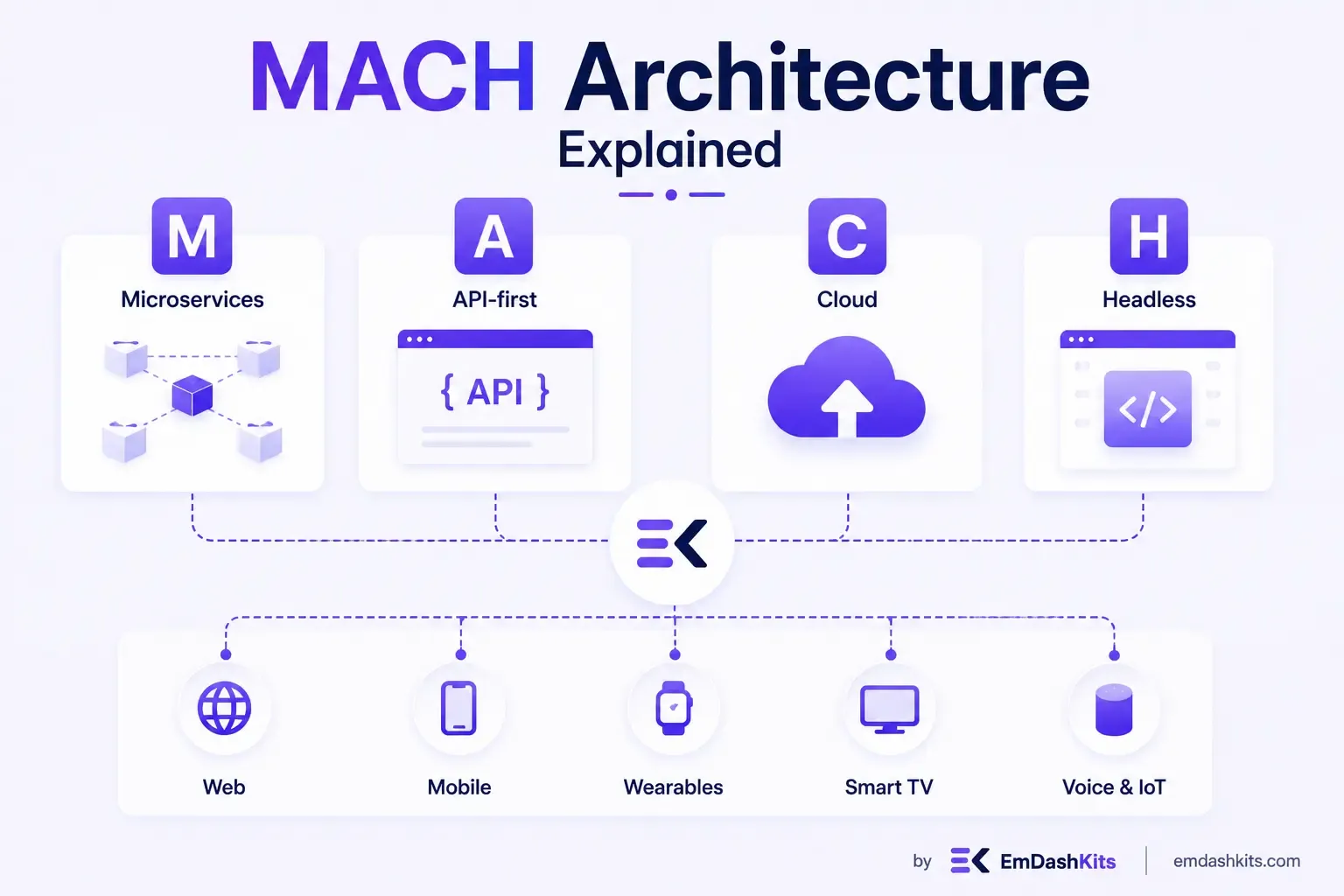
Most teams don't wake up one day and decide to rebuild their entire stack around an acronym. MACH — Microservices, API-first, Cloud-native, and Headless — became the standard label for a shift that was already happening: breaking monolithic platforms into smaller, independently deployable pieces that talk to each other over APIs. This guide walks through what each pillar actually means, why they're meant to be adopted together, and where teams commonly get it wrong.
Table of Contents
What MACH Stands For
MACH is a coalition-backed term (the MACH Alliance formalized it in 2020) describing four architectural principles that, combined, replace the single vendor-locked monolith with a set of best-of-breed, interchangeable services.
Microservices
Instead of one large application handling search, checkout, content, and personalization inside a single codebase, each capability ships as its own independently deployable service. A bug in the recommendation engine doesn't take down checkout. A team can redeploy the search service ten times a day without touching anything else.
API-First
Every capability is designed API-first — the API isn't a bolt-on integration layer added after the product ships, it's the product's actual interface. See our guide on what API-first CMS means in practice for a deeper look at this specific piece.
Cloud-Native
Services are built to run on elastic cloud infrastructure from day one — auto-scaling, containerized or serverless, deployed across regions — rather than retrofitted onto cloud servers that still assume a single fixed machine.
Headless
Content and business logic are fully decoupled from presentation. There's no bundled front end forcing a specific templating engine or theme system — you own the front end and pull content in through APIs. If you haven't already, it's worth reading our beginner's guide to headless CMS before going further into MACH specifically, since headless is the piece most people encounter first.
Why the Four Pillars Are Meant to Work Together
It's possible to be headless without being cloud-native, or API-first without being built on microservices. MACH's actual claim is narrower and more useful: these four principles reinforce each other. Microservices only stay manageable at scale if each one is genuinely API-first, so other services (and other teams) can integrate without reading the source code. Cloud-native elasticity matters more once you have a dozen independently scaling services instead of one predictable monolith. And headless only delivers on its promise of omnichannel delivery — web, app, IoT, kiosk — if the underlying services were built API-first to begin with.
This is also the piece most "MACH-washing" vendors skip. A platform can market itself as MACH-compliant while still shipping a tightly coupled monolith with a REST API glued on top. The MACH Alliance's own certification process exists specifically because self-reported compliance became unreliable as the term got popular.
MACH vs. Composable — Are They the Same Thing?
Not quite, though they're closely related and often used together. MACH describes the architectural properties a given service should have. Composable architecture is the broader strategy of assembling your entire stack from interchangeable, best-of-breed pieces — MACH is what makes a piece composable in the first place. Think of MACH as the spec each Lego brick has to meet, and composable as the act of actually building something out of those bricks.
Where MACH Shows Up First: AI-Native Workflows
The clearest practical driver for MACH adoption right now isn't a redesign or a rebrand — it's AI. Structured content models and API-first design are what let an AI agent create content, run personalization experiments, or restructure a taxonomy programmatically, in ways a monolithic system with content trapped in raw HTML templates simply can't support. This is also why AI-native CMS platforms lean so heavily on MACH principles from the start rather than retrofitting them in later.
Common Pitfalls When Adopting MACH
- Treating it as a technology purchase instead of an organizational change — teams still organized around a single monolith release cycle won't get the benefits of independently deployable services.
- Skipping content governance. More services and more content models mean more places for inconsistency to creep in without clear ownership.
- Underestimating data privacy and integration complexity once content, commerce, and personalization each live in a different vendor's system.
- Falling for "MACH-washing" — a vendor claiming compliance with the label while the underlying platform is still a monolith with an API bolted on.
None of these are reasons to avoid MACH. They're reasons to treat it the way most successful adopters do: as an incremental migration with clear ownership, not a big-bang rewrite. For a look at how this plays out for larger organizations specifically, see our guide to what enterprises actually need from a CMS.
Is MACH Right for Your Team?
MACH architecture pays off when you need to ship to multiple channels, when your content or commerce logic needs to scale independently of your marketing site, or when you're already running into the ceiling of a monolithic platform. If you're a small team shipping a single marketing site, the operational overhead of managing several independent services may not be worth it yet — a well-built headless or hybrid setup can get you most of the benefits with far less complexity. Why more businesses are making the switch to headless in 2026 digs into that decision in more detail.
Comments