Why Businesses Are Switching to Headless CMS in 2026

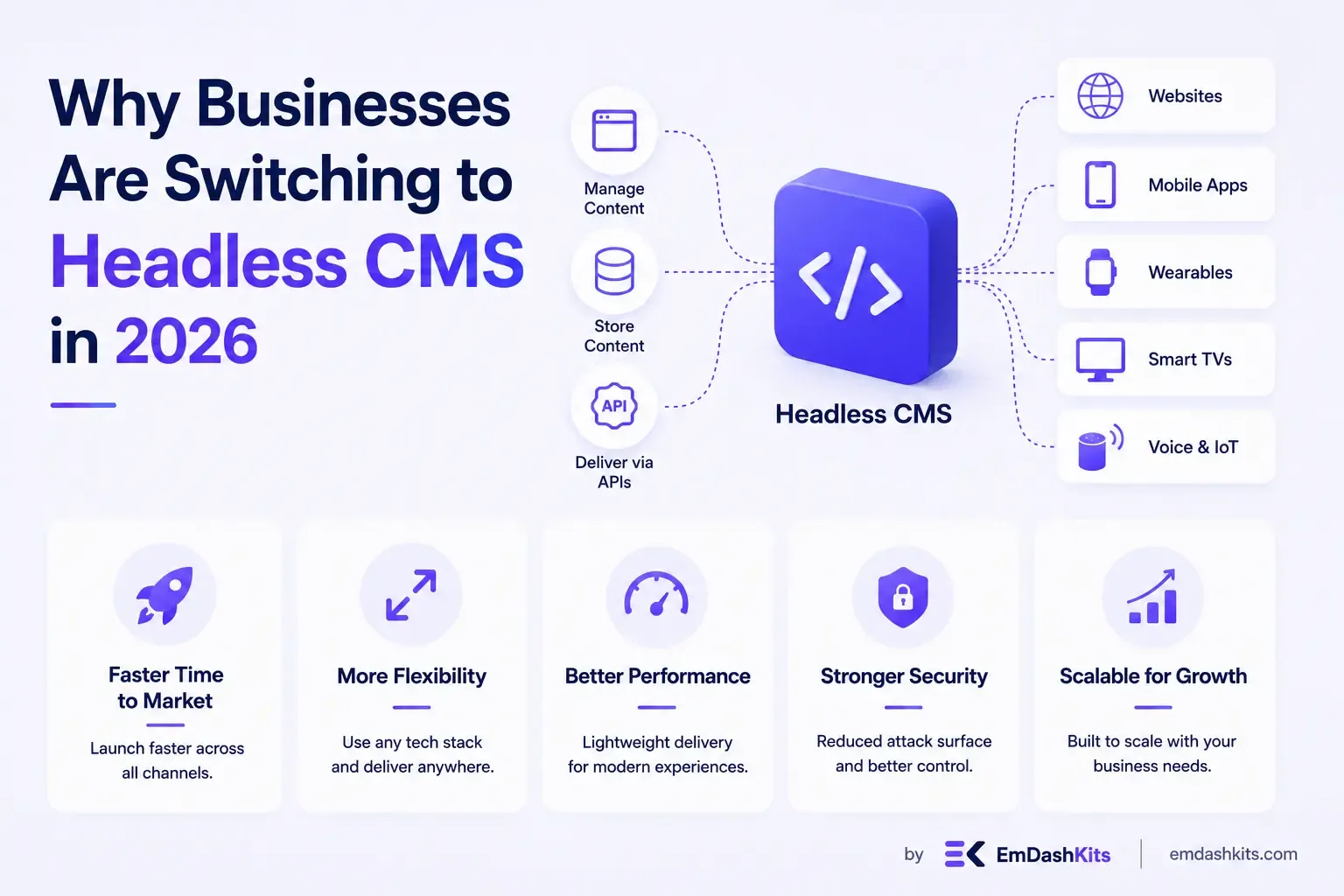
For most of the last decade, headless CMS adoption was a story about ambitious enterprises and engineering-heavy teams. That's changed. The switch is now broad enough that it shows up clearly in market data, not just conference talk tracks — and the reasons teams give for migrating in 2026 are more concrete than "it's more flexible."
Table of Contents
The Numbers Behind the Shift
Momentum is accelerating, not plateauing. In the Netherlands, 77% of companies report planning to migrate to a new CMS soon, and 86% of those already on a headless setup report increased ROI. In Germany, roughly 70% of companies that migrated saw measurable performance and scaling improvements. The headless CMS category overall — spanning platforms like Sanity, Strapi, Contentful, and others — has more than doubled its share of the CMS market even though it's still a small slice of the total.
Meanwhile, WordPress — still the largest single CMS by a wide margin — has posted its first sustained market-share decline in its 20-plus-year history, dropping from a peak above 43% in mid-2025. That's not a collapse, but it's a signal that the ground is shifting, particularly among teams choosing a platform for a new project rather than migrating an existing one.
What's Actually Driving the Switch
1. AI-Native Content Workflows
This is the newest and fastest-growing driver. Structured content and API-first delivery are what let AI agents generate content, personalize experiences, and run experiments at scale — something a monolithic CMS storing raw HTML in one big table simply isn't built for. Teams adopting headless in 2026 increasingly cite AI workflows as the primary reason, not a side benefit.
2. Security Exposure
WordPress accounted for the large majority of CMS-related vulnerability disclosures in the past year, and the overwhelming majority of those originated in its plugin ecosystem rather than WordPress core. A headless setup with a static or edge-rendered front end has a fundamentally smaller attack surface — no PHP to exploit, no admin login page exposed to the public internet, no plugin with unrestricted database access.
3. Omnichannel Delivery
Content increasingly needs to reach more than one website — mobile apps, kiosks, partner integrations, IoT displays. A traditional CMS that renders HTML server-side has no clean way to also serve that same content as structured JSON elsewhere. A headless CMS was built for that from day one.
4. Performance and Core Web Vitals
Decoupling the front end lets teams build on genuinely fast rendering approaches — static generation, edge rendering, islands architecture — instead of inheriting a template engine's rendering ceiling. For teams where SEO and page-speed scores are directly tied to revenue, this alone is often enough to justify the migration.
Who Shouldn't Switch Yet
Headless isn't the right call for everyone in 2026, and the data doesn't suggest it should be. A single-founder business, a portfolio site, or a campaign microsite is usually better served by an all-in-one builder that ships in a day — see our breakdown of traditional CMS vs. static site generators for where that line sits. Teams without any front-end engineering capacity will also feel the migration cost more than the benefit, at least until they bring on that skill set or choose a hybrid CMS that offers headless flexibility without requiring a fully custom front end.
How Teams Are Actually Migrating
- Most successful migrations run the old and new CMS in parallel for a defined content type before cutting over everything at once.
- Teams increasingly pick platforms with MACH-aligned architecture rather than a single do-everything suite — see our explainer on MACH architecture for why that combination matters.
- Security and compliance requirements are now a top-three migration driver for regulated industries, not just an engineering preference.
If you're evaluating this decision for your own team, it's worth reading through the fundamentals first: what a headless CMS actually is, how it differs from a traditional CMS, and — if you're specifically weighing this against a large-scale legacy deployment — what enterprise buyers are prioritizing this year.
Comments