EmDash CMS vs Contentful: Which One Should You Choose?

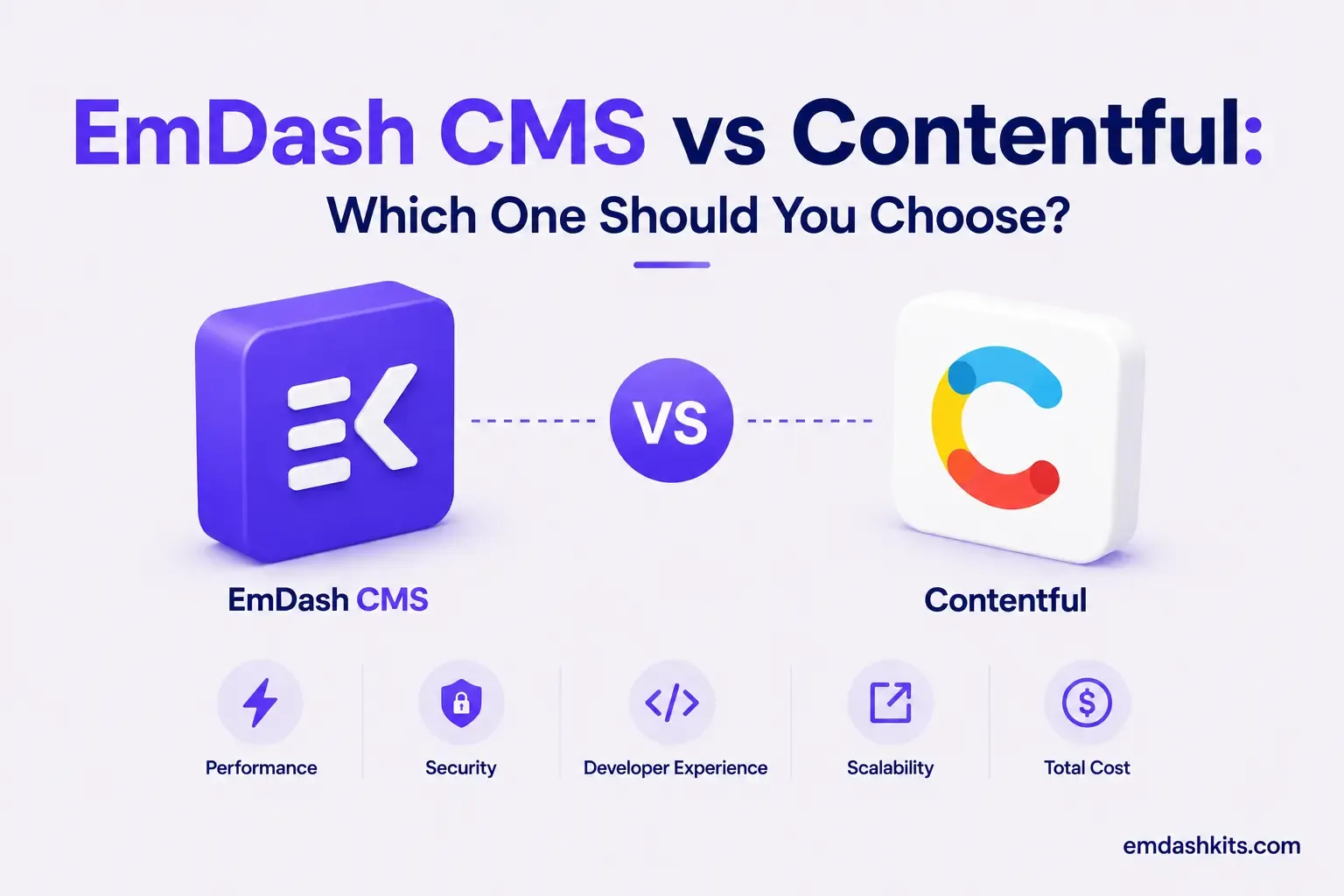
EmDash CMS vs Contentful: Which One Should You Choose?

Contentful and EmDash solve a similar underlying problem — structured, API-first content — from almost opposite directions. Contentful is a mature, managed SaaS platform built for enterprise scale. EmDash is a newer, open-source, self-hostable CMS built on Astro with security and AI-native workflows as core design goals rather than add-ons. Which one fits depends heavily on how much you value managed infrastructure versus ownership and cost control.

Table of Contents
  1. Quick Answer
  2. Pricing: Managed SaaS vs. Self-Hosted
  3. Content Modeling
  4. Where Contentful Pulls Ahead
  5. Where EmDash Pulls Ahead
  6. Security Posture
  7. The Bottom Line

Quick Answer

Contentful is the safer choice if you need a proven, fully managed platform with deep enterprise tooling and don't mind paying for it. EmDash is the better fit if you want to self-host, control your own infrastructure and costs, and get AI-native content management without an enterprise contract.

Pricing: Managed SaaS vs. Self-Hosted

Contentful's pricing scales with spaces, locales, and API call volume. Its published tiers run from free up to roughly $850/month for the Lite plan, and large enterprise deployments commonly run $80,000–$200,000+ per year once spaces, environments, and support SLAs are factored in. That cost buys real infrastructure and support, but it scales up quickly as a team or content volume grows.

EmDash is open-source and self-hosted. Its cost structure is fundamentally different: you pay for your own hosting and database rather than per-seat or per-space fees, which — as with most self-hosted platforms — means a growing content team costs roughly the same to host as a small one. The tradeoff is that you own the operational responsibility Contentful otherwise handles for you.

Read also:

Content Modeling

Contentful's content modeling is flexible and mature, with a well-established editorial UI that's had years to refine non-technical editor workflows. EmDash's content model is also structured — content is stored as portable text JSON with typed columns per content type rather than raw HTML — but the editorial tooling around it is understandably younger, having shipped far more recently than Contentful's.

Where Contentful Pulls Ahead

  • A mature partner network and deep pre-built integrations across enterprise toolchains.
  • Enterprise features like embargoed assets, locale-based publishing, and connected Spaces that have had years to mature.
  • Dedicated Customer Success Managers and guaranteed-response SLAs at the enterprise tier.
  • A large, established community and hiring pool for Contentful-specific expertise.

Where EmDash Pulls Ahead

  • No per-space or per-locale pricing — cost scales with your infrastructure, not your content model.
  • Full data ownership: your content lives in a database you control, with no vendor-managed export process.
  • Sandboxed, permission-scoped plugin architecture rather than relying entirely on app-marketplace vetting.
  • A built-in AI-native layer (MCP server) for programmatic content management, without needing an enterprise integration project.

Security Posture

Both platforms take security seriously, but from different angles. Contentful's enterprise tier includes SSO, custom roles, SCIM, and dedicated infrastructure as part of its premium offering. EmDash bakes a comparable security posture into its architecture by default — plugins run sandboxed with explicit permission grants, closer to how modern OAuth scopes work, rather than that level of isolation being an enterprise-tier upsell.

The Bottom Line

If you're an enterprise team that wants a fully managed platform, deep existing integrations, and can absorb the cost, Contentful remains one of the strongest choices in the category — see our broader look at what enterprise CMS buyers actually prioritize for more on that evaluation. If you'd rather self-host, control your own costs as you scale, and want AI-native tooling built in rather than bolted on, EmDash is worth a serious trial — particularly if you're also weighing it against other composable, API-first platforms rather than treating this as a two-horse race.
Share

Comments

Write a comment

Related Articles

Login Works in Production but Fails on localhost: The secure Cookie Flag Gotcha

July 16, 2026

Login Works in Production but Fails on localhost: The secure Cookie Flag Gotcha

Google Analytics (GA4) Not Tracking Anything and No Console Errors: Check Your CSP First

July 16, 2026

Google Analytics (GA4) Not Tracking Anything and No Console Errors: Check Your CSP First

Native Module Build Fails on Shared Hosting (node-gyp, Old glibc/Python): The .npmrc Fix

July 16, 2026

Native Module Build Fails on Shared Hosting (node-gyp, Old glibc/Python): The .npmrc Fix

Login Works in Production but Fails on localhost: The secure Cookie Flag Gotcha

Login Works in Production but Fails on localhost: The secure Cookie Flag Gotcha

TL;DR — A custom session-cookie login flow appeared to succeed on localhost (the OTP verified, the response looked fine) but every subsequent request to a login-gated page treated the visitor as logged out. Identical code worked fine on the live HTTPS site. The cookie's Secure attribute was hardcoded to true — and per the cookie spec, browsers never store or send a Secure cookie over a plain, non-HTTPS connection.

Table of Contents
  1. Diagnostic
  2. Root cause
  3. Fix
  4. Lessons learned

Diagnostic

Check the actual Set-Cookie response header and the browser's own cookie storage panel — on localhost over http://, the cookie is sent by the server but never actually stored by the browser.

Root cause

// before -- assumes the app is always served over HTTPS
setCookie("session", token, { secure: true, httpOnly: true });
emdashkits.com

A cookie config that quietly assumes "we're always on HTTPS" breaks the instant you test over plain HTTP, which local dev servers commonly are.

Read also:

Fix

// after -- derive secure from the actual request protocol
const isHttps = request.url.startsWith("https://");
setCookie("session", token, { secure: isHttps, httpOnly: true });
emdashkits.com

Lessons learned

  • Any Secure-flagged cookie needs to key off the real request scheme, not an assumption baked in once at cookie-creation time.
  • "Works in production, silently fails in local dev" is a strong signal to check cookie flags before anything else in an auth flow.
  • Check other cookies in the same codebase for the same hardcoded assumption — if one cookie has this bug, sibling cookies set the same way are worth auditing too.
Share
Previous Article

Google Analytics (GA4) Not Tracking Anything and No Console Errors: Check Your CSP First

Comments

Write a comment

Related Articles

Google Analytics (GA4) Not Tracking Anything and No Console Errors: Check Your CSP First

July 16, 2026

Google Analytics (GA4) Not Tracking Anything and No Console Errors: Check Your CSP First

Native Module Build Fails on Shared Hosting (node-gyp, Old glibc/Python): The .npmrc Fix

July 16, 2026

Native Module Build Fails on Shared Hosting (node-gyp, Old glibc/Python): The .npmrc Fix

Uploaded Images Disappear After Every Deploy on Shared Hosting (and Other Reverse-Proxy Gotchas)

July 16, 2026

Uploaded Images Disappear After Every Deploy on Shared Hosting (and Other Reverse-Proxy Gotchas)

Google Analytics (GA4) Not Tracking Anything and No Console Errors: Check Your CSP First

Google Analytics (GA4) Not Tracking Anything and No Console Errors: Check Your CSP First

TL;DR — GA4's gtag.js snippet was installed correctly, the page loaded with no visible JavaScript error, and GA4's real-time report still showed zero activity. The CMS's default Content-Security-Policy had no allowance for analytics domains and no config option to add one — so every request to Google's tracking endpoints was blocked at the browser level before it could fail loudly.

Table of Contents
  1. Diagnostic
  2. Root cause
  3. Lessons learned

Diagnostic

Check the browser's dedicated CSP violation reporting, not the regular console error list — CSP blocks are reported through their own channel, not thrown as normal script errors, so "no console errors" doesn't mean nothing was blocked.

Root cause

The CSP's script-src and connect-src directives had no entry for googletagmanager.com or google-analytics.com, and the CMS exposed no configuration surface to add one — the only way in was patching the CSP directives directly.

// patch-package: add analytics domains to the existing CSP directives
scriptSrc.push("https://www.googletagmanager.com");
connectSrc.push("https://www.google-analytics.com", "https://www.googletagmanager.com");
emdashkits.com
Read also:

Lessons learned

  • "No console errors" is not proof nothing was blocked — CSP violations live in their own reporting surface and are easy to miss if you're only scanning for red error text.
  • Before adding any third-party script tag to a site with a CSP already in place, check the CSP's directives first rather than assuming a silently-empty analytics dashboard means a snippet-installation mistake.
Share
Previous Article

Native Module Build Fails on Shared Hosting (node-gyp, Old glibc/Python): The .npmrc Fix

Next Article

Login Works in Production but Fails on localhost: The secure Cookie Flag Gotcha

Comments

Write a comment

Related Articles

Login Works in Production but Fails on localhost: The secure Cookie Flag Gotcha

July 16, 2026

Login Works in Production but Fails on localhost: The secure Cookie Flag Gotcha

Native Module Build Fails on Shared Hosting (node-gyp, Old glibc/Python): The .npmrc Fix

July 16, 2026

Native Module Build Fails on Shared Hosting (node-gyp, Old glibc/Python): The .npmrc Fix

Uploaded Images Disappear After Every Deploy on Shared Hosting (and Other Reverse-Proxy Gotchas)

July 16, 2026

Uploaded Images Disappear After Every Deploy on Shared Hosting (and Other Reverse-Proxy Gotchas)