Best Storyblok Alternatives in 2026 (Including EmDash CMS)

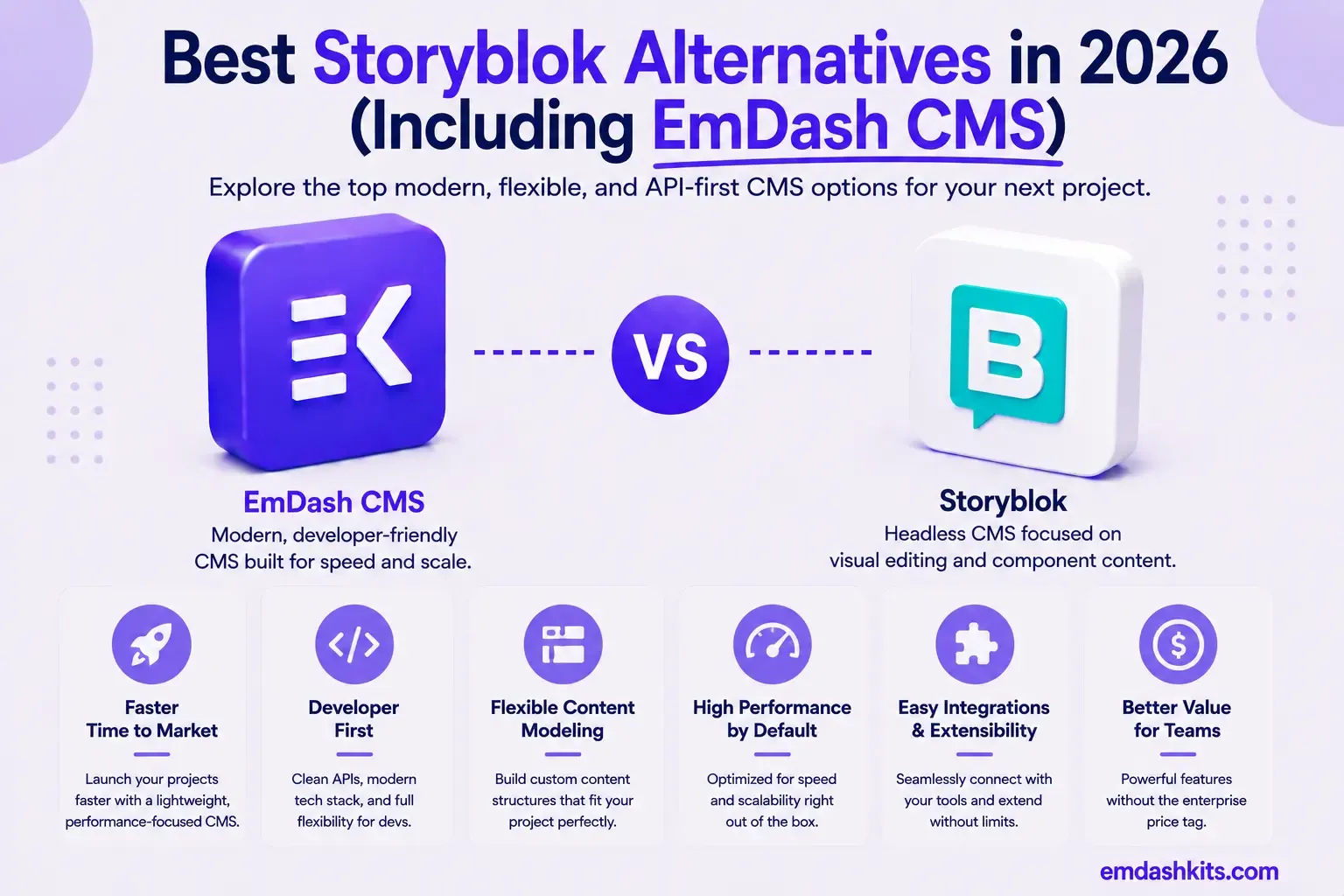
Storyblok's visual, component-based editor genuinely solved a real problem — giving marketers a live, drag-and-drop preview on top of a real headless API, rather than making them choose between the two. The reasons teams look elsewhere are concentrated almost entirely in one area: pricing, and specifically how it scales as a team or content operation grows. This guide rounds up the strongest alternatives.
Table of Contents
- The Recurring Complaint, in Their Own Words
- The Alternatives, Organized by What They Solve
- EmDash CMS — Best Self-Hosted Escape from Seat-and-Traffic Pricing
- Builder.io — Best for AI-Assisted Visual Editing on Your Own Codebase
- Contentful — Best for Teams Prioritizing Enterprise API Maturity Over Visual Editing
- Sanity — Best for Real-Time Collaboration Without Storyblok's Visual Canvas
- Prismic — Best for Reusable Page-Building Blocks (Slices) Without Storyblok's Price Curve
- How to Actually Choose
- Frequently Asked Questions
- Did Storyblok actually fix its pricing complaints?
- Is there a self-hosted alternative with Storyblok's visual editor?
- What's the real cost difference between Storyblok and a self-hosted alternative like EmDash?
- Is visual editing worth Storyblok's pricing for a small team?
- The Bottom Line
- Sources
The Recurring Complaint, in Their Own Words
Pricing is the single most frequently cited concern across G2 reviews, with reviewers repeatedly flagging the steep jump from the free Starter tier to the $99 Growth plan, and several noting that Storyblok's pricing has increased over time, with one reviewer reporting a 3x cost increase. The jump between the Entry and Business plan being too great made it more difficult for businesses to scale their content operations.
Worth noting: Storyblok has acknowledged this directly and introduced 2026 pricing changes aimed at giving customers more flexibility as they scale — a real, positive response, and worth checking against your specific plan before assuming the old complaints still fully apply. That said, the underlying dynamic (pricing tied to seats and traffic) is architectural, not just a pricing-table detail, so it's still the central question for anyone evaluating Storyblok against a self-hosted alternative.
The Alternatives, Organized by What They Solve
EmDash CMS — Best Self-Hosted Escape from Seat-and-Traffic Pricing
EmDash has no per-seat or per-traffic pricing at all — the direct structural answer to Storyblok's most common complaint, since cost is your own infrastructure regardless of team size or content volume. It doesn't match Storyblok's visual, live-preview editor, which is a real trade-off for marketer-led teams. Full comparison: EmDash CMS vs Storyblok.
Builder.io — Best for AI-Assisted Visual Editing on Your Own Codebase
Builder.io offers a comparable visual-editing experience to Storyblok — arguably more advanced, with AI-assisted Figma-to-code generation — while sitting on top of your existing codebase rather than requiring a full platform migration. Its own per-user pricing ($19-24/month) is worth comparing directly against Storyblok's tiers for your specific team size. Full comparison: EmDash CMS vs Builder.io.
Contentful — Best for Teams Prioritizing Enterprise API Maturity Over Visual Editing
Contentful trades Storyblok's visual editor for deeper enterprise API maturity and localization tooling — a reasonable swap if your team has concluded visual editing wasn't worth Storyblok's specific pricing curve. Worth weighing against Contentful's own 2026 pricing increases and the Salesforce acquisition. Full comparison: EmDash CMS vs Contentful.
Sanity — Best for Real-Time Collaboration Without Storyblok's Visual Canvas
Sanity swaps Storyblok's visual, in-context editing for real-time collaborative editing (multiple people in the same document simultaneously) — a different kind of marketer-friendly capability, with its own per-seat pricing considerations worth weighing against Storyblok's. Full comparison: EmDash CMS vs Sanity.
Prismic — Best for Reusable Page-Building Blocks (Slices) Without Storyblok's Price Curve
Prismic's slice-based content modeling solves a similar problem to Storyblok's components — reusable blocks marketers assemble into pages — with a genuinely free tier for developers, though Prismic has its own documented history of steep mid-contract price increases worth checking carefully. Full comparison: EmDash CMS vs Prismic.
How to Actually Choose
- If per-seat/traffic pricing at scale is your core objection and visual editing isn't essential: EmDash.
- If you want comparable (or better) visual editing without migrating your codebase: Builder.io.
- If you're willing to trade visual editing for deeper enterprise API maturity: Contentful.
- If real-time collaborative editing matters more than a visual canvas: Sanity.
- If reusable page-building blocks are the core need, at a lower entry price: Prismic (watch its own pricing history).
Frequently Asked Questions
Did Storyblok actually fix its pricing complaints?
It made a real, acknowledged effort — 2026 pricing changes were introduced specifically to give customers more flexibility scaling their content operations. Worth evaluating your specific current plan against those changes before assuming older reviews still fully apply.
Is there a self-hosted alternative with Storyblok's visual editor?
Not exactly matching it — EmDash doesn't have an equivalent visual canvas. Builder.io is the closest to Storyblok's visual-editing experience while sitting on your own codebase rather than a fully separate self-hosted platform.
What's the real cost difference between Storyblok and a self-hosted alternative like EmDash?
It depends heavily on team size and traffic — Storyblok's seat-and-traffic-based pricing scales directly with usage, while EmDash's cost is infrastructure-only, flat regardless of how many editors or how much traffic you have. For a large team or high-traffic site, that gap can be substantial.
Is visual editing worth Storyblok's pricing for a small team?
For a small marketing team without developer support for every content change, quite possibly yes — visual editing has real workflow value. The complaints concentrate specifically at the scaling stage, not at the entry level.
The Bottom Line
Storyblok's visual editor remains a genuine differentiator, and its 2026 pricing changes are a real response to legitimate scaling complaints — worth re-evaluating before assuming you need to switch. If pricing at scale is still the blocker, EmDash removes seat-and-traffic cost entirely (at the cost of visual editing), while Builder.io offers a comparable visual experience without a full platform migration. See our broader look at what a hybrid CMS is for more on platforms that blend visual editing with headless architecture.
Comments