EmDash CMS vs Optimizely CMS: Which One Should You Choose?

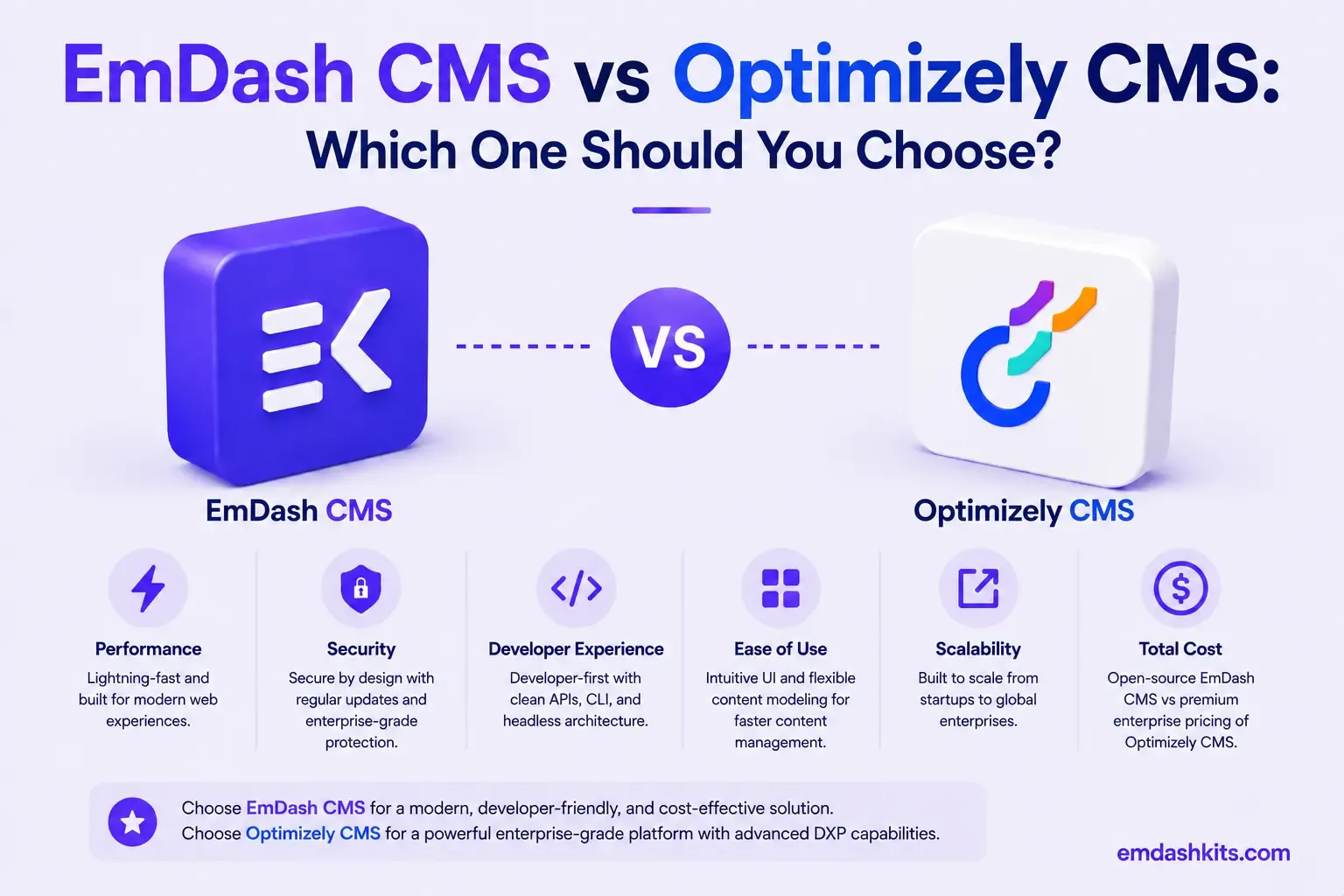
Optimizely CMS isn't really a CMS in the narrow sense — it's the content layer of a much larger digital experience platform spanning content, commerce, and experimentation. EmDash is a focused, structured CMS with no equivalent commerce or A/B testing suite built in. This comparison matters most for teams trying to figure out whether they actually need Optimizely's full DXP scope, or whether that's paying for capability they won't use.
Table of Contents
- Quick Answer
- Pricing That's Deliberately Not Public
- A Modular Suite, Not Just a CMS
- Personalization and A/B Testing
- .NET Foundation
- Where Optimizely Pulls Ahead
- Where EmDash Pulls Ahead
- Frequently Asked Questions
- Do I need Optimizely's full DXP suite, or just the CMS?
- Why doesn't Optimizely publish its pricing?
- Is the sticker price the real cost of Optimizely?
- Can EmDash replace Optimizely for a large enterprise?
- The Bottom Line
- Sources
Quick Answer
Optimizely is the stronger choice for large enterprises that need content, commerce, and experimentation/personalization unified under one platform, and have the budget — realistically six figures or more annually — to match. EmDash is the stronger choice for teams that need structured content management specifically, without an enterprise DXP price tag attached.
Pricing That's Deliberately Not Public
Optimizely doesn't publish pricing, and that's by design — the company uses custom quotes based on traffic volume, module selection, and organizational complexity. Basic implementations typically start around $25,000–$40,000 annually, mid-market deployments commonly land between $65,000–$120,000, and enterprise deals with multiple products regularly reach $120,000–$200,000 or beyond.
Those numbers are before implementation. 2026 buyer guides specifically warn that initial quotes typically represent only 25–40% of Year 1 costs once professional services and overages are factored in, with implementation and integration work commonly adding 100–200% on top of platform licensing alone. This is genuinely important to internalize before evaluating Optimizely against anything else in this comparison series: the license quote is not the real cost of ownership. EmDash's self-hosted model has no equivalent hidden multiplier — infrastructure and development costs are direct, not a fraction of a much larger implementation project.
A Modular Suite, Not Just a CMS
Optimizely's pricing is structured around three core product families — Content Cloud (CMS), Commerce Cloud (ecommerce), and Intelligence Cloud (experimentation and personalization) — with bundling discounts when combining products. That modularity is a real strength if you need all three and want one vendor relationship instead of three. It's also exactly why the price climbs so quickly: adding Commerce or Intelligence Cloud to a CMS deployment is effectively buying a second or third product, each with its own licensing tier. EmDash doesn't have commerce or experimentation modules at all — it's scoped to structured content management, full stop.
Personalization and A/B Testing
This is Optimizely's specific enterprise strength and the reason many large organizations choose it regardless of cost: mature, built-in experimentation and personalization tooling, tightly integrated with the content layer, refined over many years of enterprise deployments. EmDash has no equivalent A/B testing or personalization engine — that's simply not the problem it's built to solve. A team that needs sophisticated, content-integrated experimentation at scale has real reasons to consider Optimizely despite the cost; a team that just needs to manage structured content doesn't need to pay for that capability.
.NET Foundation
Optimizely CMS is built on .NET, positioning it — like Umbraco and Sitecore — as a natural fit for organizations already standardized on Microsoft's stack. EmDash is TypeScript/Astro throughout, a different ecosystem entirely. If your organization has already committed to .NET infrastructure, that's a real factor independent of feature comparisons.
Where Optimizely Pulls Ahead
- Mature, content-integrated personalization and A/B testing at genuine enterprise scale.
- A unified suite spanning content, commerce, and experimentation under one vendor relationship.
- Deep enterprise support, professional services, and implementation partners available.
- Natural fit for organizations already standardized on .NET infrastructure.
Where EmDash Pulls Ahead
- No enterprise DXP pricing — realistically no deployment starting at $25,000+ per year before implementation.
- Sandboxed, permission-scoped plugin security for teams that don't need a full experimentation suite.
- Simpler, more predictable costs — no 100–200% implementation multiplier on top of licensing.
- A built-in MCP server for AI-native content management, included rather than a separate module.
Frequently Asked Questions
Do I need Optimizely's full DXP suite, or just the CMS?
If personalization, A/B testing, or integrated commerce aren't active requirements, you likely don't need the full suite — and a more focused, lower-cost CMS like EmDash may serve the actual content-management need without the DXP premium.
Why doesn't Optimizely publish its pricing?
Its cost depends heavily on which products you need, traffic volume, and implementation complexity — custom quoting lets Optimizely price based on the specific deal rather than a one-size-fits-all rate card, which is standard practice for enterprise DXP vendors at this scale.
Is the sticker price the real cost of Optimizely?
No — buyer guides consistently warn that the initial quote represents a fraction of Year 1 total cost once professional services, integrations, and implementation are included. Budget well beyond the licensing number.
Can EmDash replace Optimizely for a large enterprise?
For content management specifically, potentially yes. For an organization that genuinely needs integrated commerce and enterprise-grade experimentation alongside content, EmDash isn't a full replacement — those capabilities simply aren't part of its scope.
The Bottom Line
If you need integrated content, commerce, and experimentation at true enterprise scale, and the budget realistically supports six figures or more annually, Optimizely's DXP suite is built for exactly that. If your actual need is structured content management, EmDash delivers that without the DXP price tag attached to capabilities you may never use. See our broader guide to what enterprise CMS buyers actually prioritize for help separating genuine requirements from nice-to-haves.
Comments