The Real Cost of Running WordPress: Hosting, Plugins, and Maintenance

The Real Cost of Running WordPress: Hosting, Plugins, and Maintenance

"WordPress is free" is true in the same way that "the car was a gift" is true when you're paying for fuel, insurance, parking, and a mechanic on retainer. The software costs nothing; running it as a serious business website costs real money every month, spread across enough small invoices that most owners never see the total. Let's add it up honestly — the WordPress maintenance cost, hosting, plugin licenses, and the hidden lines that only show up after a bad week.

Printed bar charts and financial documents next to a laptop, representing a website cost breakdown
The total only becomes visible when you put every invoice on the same table. Source: Pexels
Table of Contents
  1. Hosting: $240–$2,400 per Year
  2. Premium Plugins: $200–$1,000 per Year
  3. Maintenance: the Line That Grows
  4. The Hidden Lines
  5. A Realistic Annual Total
  6. The Comparison That Matters

Hosting: $240–$2,400 per Year

Cheap shared hosting starts around $5–10/month and is fine right up until it isn't — the first traffic spike or slow-query plugin exposes it. Managed WordPress hosting (Kinsta, WP Engine, and similar), which handles updates, staging, and CDN, runs $30–100+ per month for a single business site. E-commerce and high-traffic sites climb from there. The uncomfortable part: much of what managed WordPress hosting charges for — caching layers, security hardening, update management — is work created by the platform itself.

Premium Plugins: $200–$1,000 per Year

A typical business site's paid stack looks something like: a form builder ($50–200/yr), an SEO plugin's premium tier ($99/yr), a caching/performance plugin ($60–250/yr), a backup service ($50–150/yr), and a page builder or theme license ($50–300/yr). Individually reasonable; together they're a recurring $200–1,000 every year, and each renewal is priced knowing that leaving is painful. If the site was built on Elementor or Divi, that dependency has its own exit costs — we cover those in escaping page builder lock-in.

Read also:

Maintenance: the Line That Grows

Somebody has to apply updates, test that nothing broke, and fix it when something does. The market rates are well documented: DIY costs your time (typically 2–5 hours a month done properly), while professional WordPress maintenance plans run roughly $100–1,000+ per month depending on site complexity, with e-commerce at the top of the range. This is the largest single line item for most businesses — larger than hosting and plugins combined — and it exists because a WordPress site left alone for six months is a liability, not an asset.

The Hidden Lines

  • Incident recovery. A hacked site means emergency developer hours, potential blacklist removal, and lost sales during downtime. With 91% of WordPress vulnerabilities coming from plugins, the risk scales with your plugin count.
  • Performance consulting. 'Make the site faster' engagements are a cottage industry precisely because speed isn't the default. Budget $500–2,000 per attempt.
  • The redesign tax. Because themes couple content to presentation, redesigns often mean partial rebuilds every 3–4 years rather than restyling.
  • Developer friction. Every small change estimated with a WordPress premium — hard to see on any invoice, easy to feel over a year of sprints.

A Realistic Annual Total

For a professionally run small-business site, a typical year looks like:

  • Managed hosting: $360–1,200
  • Premium plugin renewals: $200–1,000
  • Maintenance (service or honest DIY time): $1,200–6,000
  • One incident, speed project, or 'small rebuild': $500–2,000 amortized

Total: roughly $2,300–10,000 per year — for the platform alone, before any new feature or content work. Larger sites and stores multiply from there.

The Comparison That Matters

The question isn't whether that number is outrageous — it's what the same money buys elsewhere. Modern static-first platforms remove entire categories from the list: no caching plugin because pages are pre-rendered, no security retainer for the public site because there's no PHP runtime to attack, far fewer plugins because the fundamentals are built in. We've published EmDash's pricing math and a head-to-head EmDash vs WordPress comparison if you want to run the numbers for your own site.

And if the total above made you wince, that's one of the nine signs it's time to leave — the migration itself costs less than most teams assume, especially compared to another year of the status quo.
Share

Comments

Write a comment

Related Articles

Login Works in Production but Fails on localhost: The secure Cookie Flag Gotcha

July 16, 2026

Login Works in Production but Fails on localhost: The secure Cookie Flag Gotcha

Google Analytics (GA4) Not Tracking Anything and No Console Errors: Check Your CSP First

July 16, 2026

Google Analytics (GA4) Not Tracking Anything and No Console Errors: Check Your CSP First

Native Module Build Fails on Shared Hosting (node-gyp, Old glibc/Python): The .npmrc Fix

July 16, 2026

Native Module Build Fails on Shared Hosting (node-gyp, Old glibc/Python): The .npmrc Fix

Login Works in Production but Fails on localhost: The secure Cookie Flag Gotcha

Login Works in Production but Fails on localhost: The secure Cookie Flag Gotcha

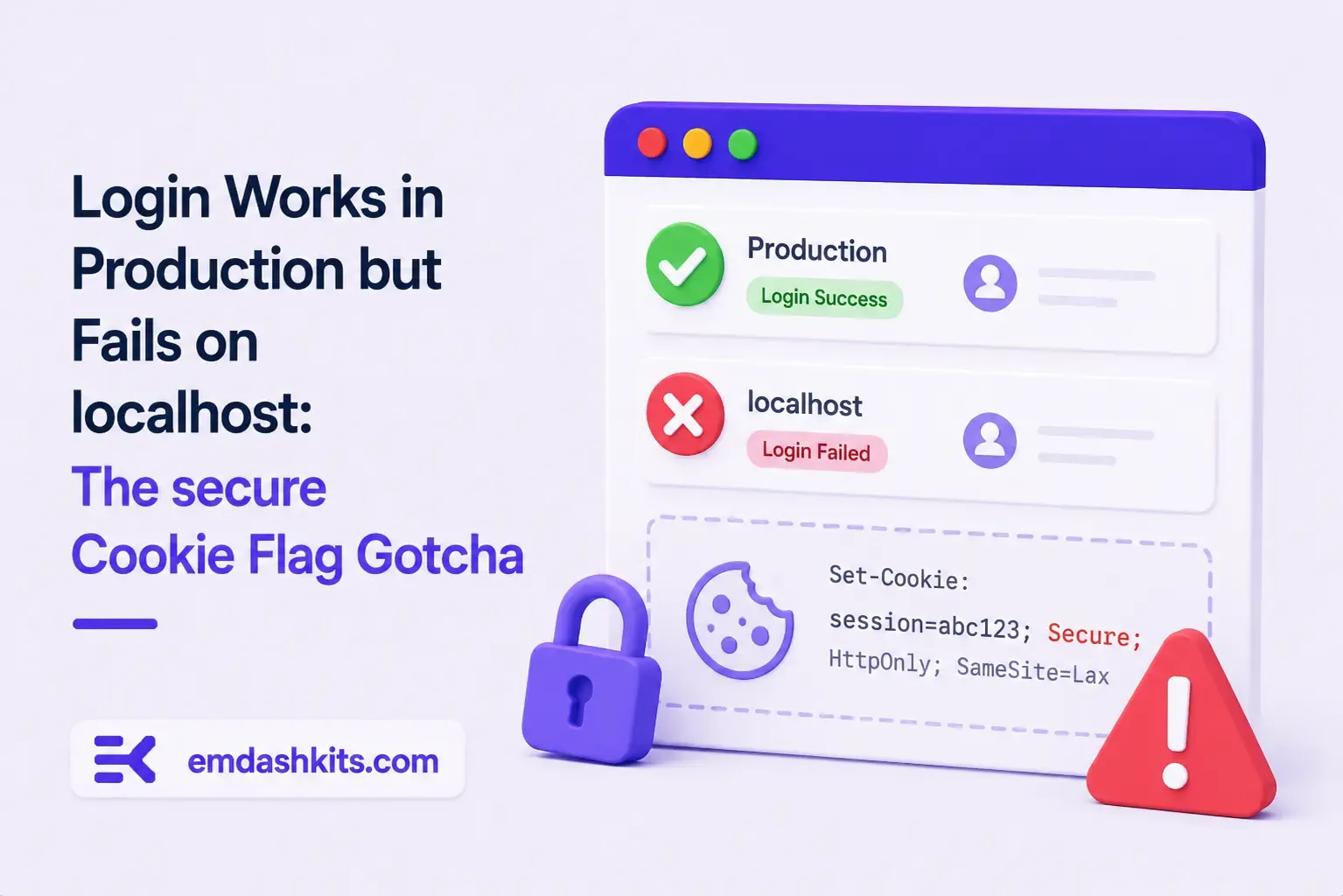
TL;DR — A custom session-cookie login flow appeared to succeed on localhost (the OTP verified, the response looked fine) but every subsequent request to a login-gated page treated the visitor as logged out. Identical code worked fine on the live HTTPS site. The cookie's Secure attribute was hardcoded to true — and per the cookie spec, browsers never store or send a Secure cookie over a plain, non-HTTPS connection.

Table of Contents
  1. Diagnostic
  2. Root cause
  3. Fix
  4. Lessons learned

Diagnostic

Check the actual Set-Cookie response header and the browser's own cookie storage panel — on localhost over http://, the cookie is sent by the server but never actually stored by the browser.

Root cause

// before -- assumes the app is always served over HTTPS
setCookie("session", token, { secure: true, httpOnly: true });
emdashkits.com

A cookie config that quietly assumes "we're always on HTTPS" breaks the instant you test over plain HTTP, which local dev servers commonly are.

Read also:

Fix

// after -- derive secure from the actual request protocol
const isHttps = request.url.startsWith("https://");
setCookie("session", token, { secure: isHttps, httpOnly: true });
emdashkits.com

Lessons learned

  • Any Secure-flagged cookie needs to key off the real request scheme, not an assumption baked in once at cookie-creation time.
  • "Works in production, silently fails in local dev" is a strong signal to check cookie flags before anything else in an auth flow.
  • Check other cookies in the same codebase for the same hardcoded assumption — if one cookie has this bug, sibling cookies set the same way are worth auditing too.
Share
Previous Article

Google Analytics (GA4) Not Tracking Anything and No Console Errors: Check Your CSP First

Comments

Write a comment

Related Articles

Google Analytics (GA4) Not Tracking Anything and No Console Errors: Check Your CSP First

July 16, 2026

Google Analytics (GA4) Not Tracking Anything and No Console Errors: Check Your CSP First

Native Module Build Fails on Shared Hosting (node-gyp, Old glibc/Python): The .npmrc Fix

July 16, 2026

Native Module Build Fails on Shared Hosting (node-gyp, Old glibc/Python): The .npmrc Fix

Uploaded Images Disappear After Every Deploy on Shared Hosting (and Other Reverse-Proxy Gotchas)

July 16, 2026

Uploaded Images Disappear After Every Deploy on Shared Hosting (and Other Reverse-Proxy Gotchas)

Google Analytics (GA4) Not Tracking Anything and No Console Errors: Check Your CSP First

Google Analytics (GA4) Not Tracking Anything and No Console Errors: Check Your CSP First

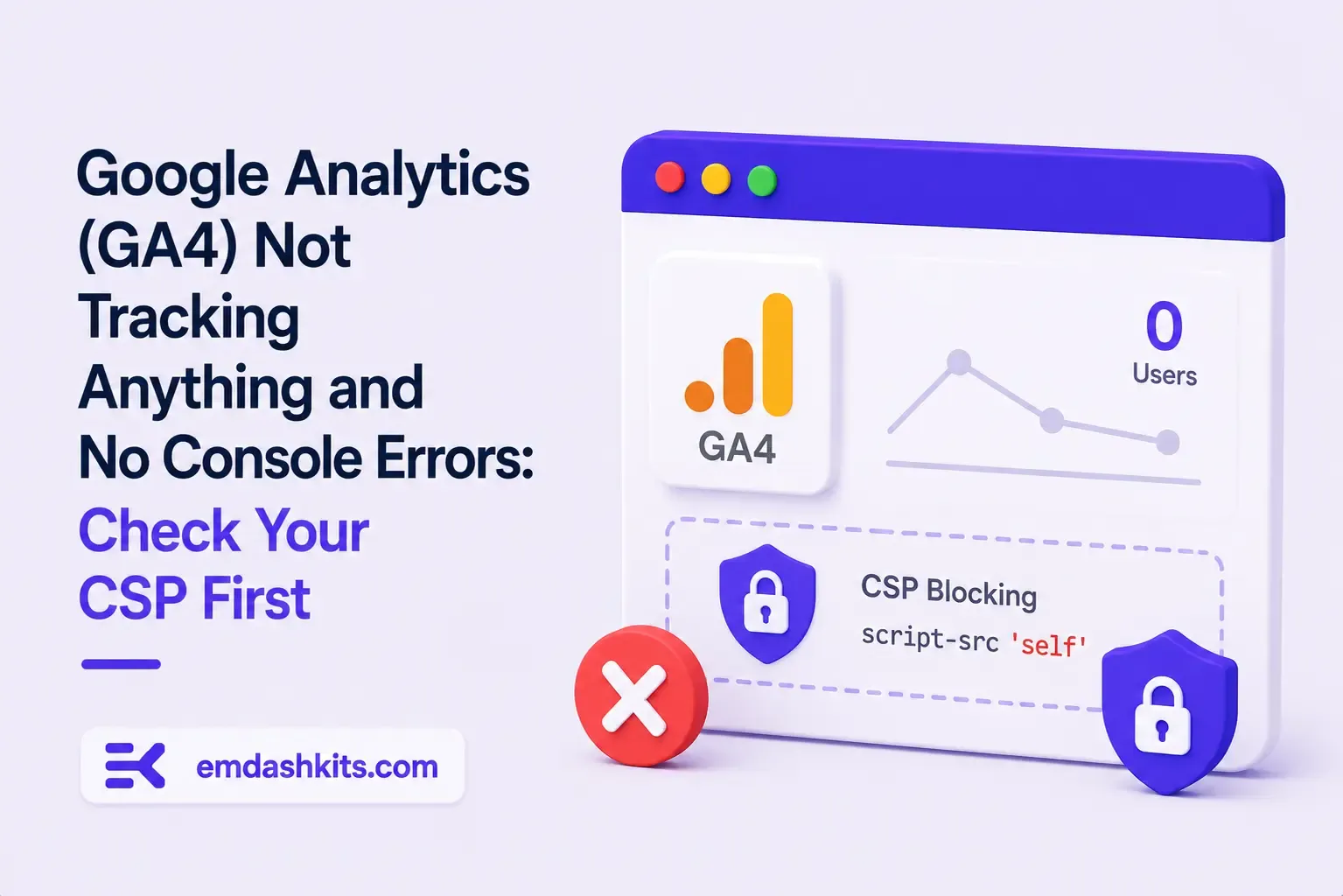
TL;DR — GA4's gtag.js snippet was installed correctly, the page loaded with no visible JavaScript error, and GA4's real-time report still showed zero activity. The CMS's default Content-Security-Policy had no allowance for analytics domains and no config option to add one — so every request to Google's tracking endpoints was blocked at the browser level before it could fail loudly.

Table of Contents
  1. Diagnostic
  2. Root cause
  3. Lessons learned

Diagnostic

Check the browser's dedicated CSP violation reporting, not the regular console error list — CSP blocks are reported through their own channel, not thrown as normal script errors, so "no console errors" doesn't mean nothing was blocked.

Root cause

The CSP's script-src and connect-src directives had no entry for googletagmanager.com or google-analytics.com, and the CMS exposed no configuration surface to add one — the only way in was patching the CSP directives directly.

// patch-package: add analytics domains to the existing CSP directives
scriptSrc.push("https://www.googletagmanager.com");
connectSrc.push("https://www.google-analytics.com", "https://www.googletagmanager.com");
emdashkits.com
Read also:

Lessons learned

  • "No console errors" is not proof nothing was blocked — CSP violations live in their own reporting surface and are easy to miss if you're only scanning for red error text.
  • Before adding any third-party script tag to a site with a CSP already in place, check the CSP's directives first rather than assuming a silently-empty analytics dashboard means a snippet-installation mistake.
Share
Previous Article

Native Module Build Fails on Shared Hosting (node-gyp, Old glibc/Python): The .npmrc Fix

Next Article

Login Works in Production but Fails on localhost: The secure Cookie Flag Gotcha

Comments

Write a comment

Related Articles

Login Works in Production but Fails on localhost: The secure Cookie Flag Gotcha

July 16, 2026

Login Works in Production but Fails on localhost: The secure Cookie Flag Gotcha

Native Module Build Fails on Shared Hosting (node-gyp, Old glibc/Python): The .npmrc Fix

July 16, 2026

Native Module Build Fails on Shared Hosting (node-gyp, Old glibc/Python): The .npmrc Fix

Uploaded Images Disappear After Every Deploy on Shared Hosting (and Other Reverse-Proxy Gotchas)

July 16, 2026

Uploaded Images Disappear After Every Deploy on Shared Hosting (and Other Reverse-Proxy Gotchas)